 English
 日本語
日本語 русский
 Español




Customer expresses intent; Communicate between the two parties; Provide analysis reports to customers; Reach a cooperation intention.
Content
- 1 The Best Base for a Carport: Concrete Wins, But It's Not the Only Option
- 2 Why the Base Matters More Than Most People Think
- 3 Concrete Slab: The Gold Standard for Carport Bases
- 4 Gravel: The Budget-Friendly Alternative
- 5 Asphalt: A Middle Ground Worth Considering
- 6 Paving Slabs and Block Paving: Attractive but Demanding
- 7 Carport Base Comparison: Key Factors at a Glance
- 8 Soil Type and Ground Conditions: What You're Working With
- 9 Anchoring Carport Posts: How Your Base Choice Affects Structural Security
- 10 Planning Permission and Building Regulations for Carport Bases
- 11 How to Choose the Right Base for Your Specific Situation
- 12 Frequently Asked Questions About Carport Bases
- 12.1 Can I put a carport on an existing concrete driveway?
- 12.2 How thick should a concrete slab be for a carport?
- 12.3 Does a carport need footings or just a slab?
- 12.4 What is the cheapest base for a carport?
- 12.5 Do I need a permit to pour a concrete base for a carport?
- 12.6 How long does a concrete carport base last?
The Best Base for a Carport: Concrete Wins, But It's Not the Only Option
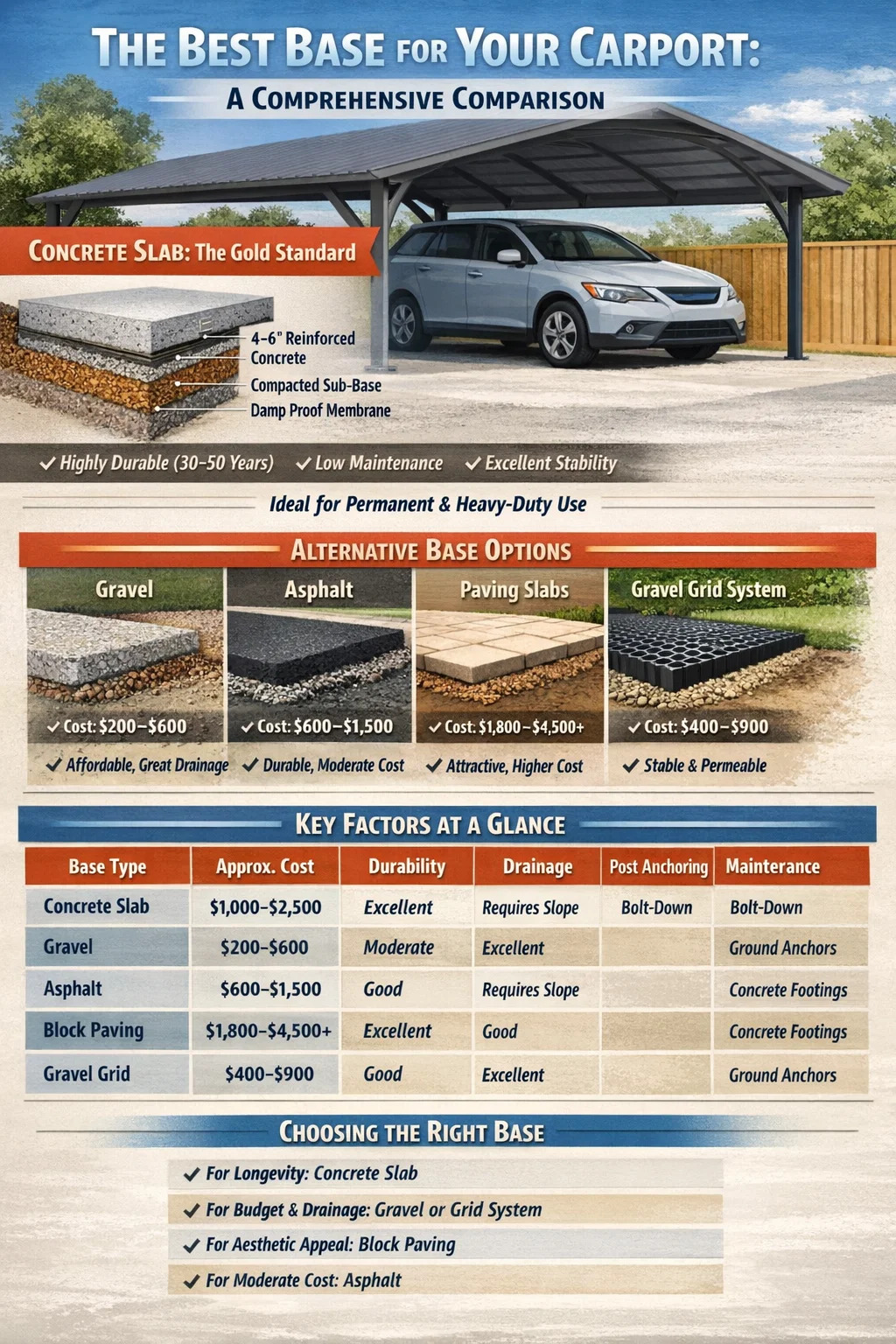
If you want a direct answer: a reinforced concrete slab is the best base for a carport in most situations. It offers unmatched stability, longevity, and load-bearing capacity. A properly poured concrete slab — typically 4 inches thick for a standard carport, or 6 inches if you're parking heavy trucks or SUVs — will outlast the carport structure itself and requires almost zero maintenance once cured. That said, concrete isn't always the right call. Gravel, asphalt, paving slabs, and compacted hardcore all have legitimate use cases depending on your budget, soil type, drainage requirements, and whether the carport is temporary or permanent.
This guide breaks down every realistic base option for a carport, with honest comparisons on cost, installation difficulty, drainage performance, and long-term durability. Whether you're building a freestanding metal carport, a timber-framed structure, or a lean-to attached to your garage, the base you choose will directly affect how the whole project performs over time.
Why the Base Matters More Than Most People Think
A carport is only as stable as the ground it sits on. Poor base preparation is the single most common reason carport structures shift, lean, or fail within a few years. The base has to handle several types of stress simultaneously: the dead weight of the structure itself, the dynamic load of vehicles driving on and parking repeatedly, lateral wind pressure transmitted through the frame, and the constant movement of soil caused by freeze-thaw cycles, heavy rain, and drainage issues.
Consider this: a standard family car weighs somewhere between 1,500 kg and 2,200 kg. An SUV or pickup truck can push past 3,000 kg. Every time one of those vehicles pulls in, that weight is transferred through the tires to the ground in a concentrated area. Without a properly engineered base, the ground compresses unevenly, posts start to tilt, and the entire carport frame goes out of square. Once that happens, doors don't close properly, roof panels start to leak at the joins, and in worst cases, a strong wind can topple the whole structure.
Beyond structural integrity, the base also affects drainage. A poorly drained carport area leads to standing water, which accelerates corrosion on steel frames and footings, rots timber posts, and creates a slip hazard. A well-chosen and well-installed base manages water runoff efficiently, directing it away from both the structure and the building it's attached to.
Concrete Slab: The Gold Standard for Carport Bases
Concrete remains the top choice for carport bases for good reason. When properly installed, a concrete slab provides a flat, stable, and weather-resistant surface that can handle virtually any vehicle weight and lasts for 30 to 50 years with minimal upkeep.
Slab Thickness and Reinforcement
For a standard passenger car carport, 4 inches (100mm) of concrete is the minimum recommended thickness. If you plan to park heavy vehicles such as camper vans, utility trucks, or multiple vehicles, go to 6 inches (150mm). Reinforcement is non-negotiable — either steel rebar (typically 10mm or 12mm diameter in a grid pattern) or fiber-reinforced concrete mesh should be embedded in the slab. Unreinforced concrete will develop cracks within a few years, especially in areas with ground movement or frost.
The concrete mix also matters. A C25/30 mix (25 MPa characteristic compressive strength) is standard for residential driveways and carport slabs. In areas subject to heavy frost, specify an air-entrained mix, which introduces microscopic air bubbles that help the concrete survive freeze-thaw cycles without spalling.
Sub-Base Preparation
The concrete slab doesn't sit directly on native soil. A proper sub-base of 4 to 6 inches of compacted hardcore or crushed stone (MOT Type 1 is the standard in the UK; Class II aggregate base in the US) must be laid and compacted before the slab is poured. This layer distributes the load, improves drainage under the slab, and prevents the slab from cracking as the ground settles. Skip this step and you'll be dealing with slab settlement and cracking far sooner than you should.
In areas with clay-heavy soil, it's also advisable to install a damp proof membrane (a heavy-duty polythene sheet) between the sub-base and the concrete. This prevents ground moisture from migrating up through the slab, which can affect vehicle cleanliness and, more importantly, accelerate the corrosion of any steel anchor bolts or post bases embedded in the concrete.
Cost of a Concrete Carport Base
Costs vary significantly by region, but as a rough guide, a ready-mix concrete slab for a single-car carport (approximately 3m x 5.5m = 16.5 sqm) typically costs between $1,000 and $2,500 USD installed in the United States, or £800 to £1,800 in the UK, including excavation, sub-base, formwork, concrete, and finishing. A double carport (around 6m x 5.5m) roughly doubles that cost. DIY pouring is possible but physically demanding and requires specific equipment — it's one area where the professional result is often worth the premium.
Drainage with Concrete
Concrete is essentially impermeable, so drainage must be planned into the design. The slab should be laid with a minimum fall of 1:80 (about 1.25%) away from the house or toward a drain channel at the front of the carport. Without this fall, water pools on the surface, leading to staining, algae growth, and potential ingress into the building. A linear drain channel at the front edge of the slab, connected to a soakaway or stormwater drain, is the cleanest solution.
Gravel: The Budget-Friendly Alternative
Loose gravel or crushed stone is the most affordable carport base option and is entirely adequate for many situations, particularly for freestanding carports on stable, well-drained ground. Installation is straightforward: excavate 6 to 8 inches, lay and compact a hardcore sub-base, then top with 2 to 3 inches of 10mm or 20mm crushed stone or pea gravel. The total material cost for a single-car area typically comes in at $200 to $600 — a fraction of concrete.
Gravel handles drainage better than any hard surface because water percolates straight through it. This is particularly valuable in areas with high rainfall or where planning regulations restrict the amount of impermeable surface on a property. In the UK, for example, any new driveway or hardstanding area over 5 sqm must use permeable materials or direct runoff to a lawn or soakaway — gravel naturally complies with this.
The downsides are real, though. Gravel shifts over time under vehicle traffic, creating ruts and thin patches that need periodic top-up. It's less comfortable to walk on than concrete, and it can be tracked into the house on shoes and tires. Anchoring carport posts in gravel requires ground anchors or driven posts rather than bolted base plates, which can complicate the installation of prefabricated carport kits.
A practical upgrade is to use a gravel grid or plastic cellular confinement system. These interlocking plastic grids are filled with gravel and prevent lateral migration of the stone. The result is a firmer, more stable surface that still drains freely and costs significantly less than concrete. Gravel grid systems typically add $3 to $8 per square foot to the material cost but dramatically extend the usable life of a gravel base.
Asphalt: A Middle Ground Worth Considering
Asphalt sits between gravel and concrete in terms of cost and performance. A properly laid asphalt surface — typically 2 to 3 inches of compacted hot-mix asphalt over a crushed stone sub-base — provides a smooth, solid vehicle surface at roughly 50 to 70% of the cost of an equivalent concrete slab.
Asphalt is more flexible than concrete, which means it handles ground movement better without cracking. In climates with significant freeze-thaw cycles, this flexibility is an advantage. It also heats up and softens slightly in extreme heat, which can cause rutting under stationary vehicle tires over time — less of a problem in temperate climates but worth noting in regions that regularly see temperatures above 35°C (95°F).
Asphalt does require periodic sealing — typically every 3 to 5 years — to prevent oxidation and water infiltration from degrading the surface. Sealcoating typically costs $0.15 to $0.25 per square foot as a DIY project or $0.25 to $0.75 per square foot professionally applied. Factor this maintenance cost in when comparing asphalt to concrete over a 20-year horizon.
For anchoring carport posts, asphalt presents the same challenges as gravel — it's not ideal for bolted base plates unless the asphalt is cut away and concrete footings are poured at the post locations. Many carport installers use this hybrid approach: asphalt or gravel for the general surface, with discrete concrete pads or footings specifically at each post location.
Paving Slabs and Block Paving: Attractive but Demanding
Concrete paving slabs or block paving (also called brick paving or permeable pavers) is the most aesthetically pleasing option and is often used when the carport is visible from the street and kerb appeal matters. Good quality block paving can significantly enhance a property's appearance and resale value.
The installation sequence is more complex than a poured slab: excavate and compact native ground, lay a sub-base of MOT Type 1 compacted to at least 100mm depth, add a bedding layer of sharp sand (typically 25–40mm), then lay the pavers with tight joints filled with kiln-dried sand. Done correctly, block paving is permeable (water drains through the joints), durable (individual blocks can be replaced if damaged), and visually attractive.
The challenge is cost — professionally laid block paving typically costs $10 to $20 per square foot installed in the US, or £50 to £100 per square meter in the UK, making it the most expensive base option. It also requires edge restraints (concrete haunching around the perimeter) to prevent the blocks from spreading outward under vehicle loads, and the jointing sand needs occasional replenishment.
For anchoring carport post bases onto block paving, concrete core holes are drilled through the paving and sub-base, and small concrete pads are cast at each post location. It's workable but adds cost and complexity to the installation.
Carport Base Comparison: Key Factors at a Glance
The table below summarises the main base options across the criteria that matter most for a carport installation.
| Base Type | Approx. Cost (single car) | Durability | Drainage | Post Anchoring | Maintenance |
|---|---|---|---|---|---|
| Concrete Slab | $1,000–$2,500 | Excellent (30–50 yrs) | Requires designed fall | Excellent (bolt-down) | Very low |
| Gravel | $200–$600 | Moderate (needs top-up) | Excellent (permeable) | Requires ground anchors | Low–moderate |
| Asphalt | $600–$1,500 | Good (15–25 yrs) | Requires designed fall | Needs concrete footings | Moderate (sealing) |
| Block Paving | $1,800–$4,500+ | Excellent (30+ yrs) | Good (permeable joints) | Needs concrete footings | Low (re-sand joints) |
| Gravel Grid System | $400–$900 | Good (10–20 yrs) | Excellent (permeable) | Requires ground anchors | Low |
Soil Type and Ground Conditions: What You're Working With
No base choice can be made sensibly without considering the ground beneath it. Soil type directly influences how much preparation work is needed, how deep the sub-base must go, and whether additional drainage measures are required.
Clay Soil
Clay is the most challenging soil type for any hardstanding project. It shrinks when dry, expands when wet, and is slow to drain. In areas with clay-heavy soil, a deeper sub-base — typically 6 to 8 inches of compacted hardcore instead of the standard 4 to 6 inches — is essential to bridge over the clay and prevent slab movement. On particularly expansive clay, structural engineers sometimes specify a deeper reinforced edge beam around the slab perimeter to resist uplift. If you're in doubt, a basic soil investigation (a few trial pits dug by hand or a ground investigation company) is money well spent before you commit to a large pour.
Sandy or Gravelly Soil
Sandy and gravelly soils are well-draining and relatively stable, making them the easiest ground conditions to work with. Standard sub-base depths are usually adequate, and drainage rarely presents a major problem. The main risk is loose surface sand migrating under loads, so good compaction of the sub-base is still important.
Made Ground or Fill
If your carport area sits on made ground — soil that has been placed there as fill rather than native undisturbed ground — treat it with caution. Made ground is often heterogeneous (mixed materials), poorly compacted, and subject to long-term settlement as organic material within it decomposes. In such cases, either excavate down to undisturbed natural ground and build up properly from there, or consider a specialist ground improvement technique such as dynamic compaction or vibro stone columns if the fill depth is significant.
Frost-Susceptible Soils
In cold climates, certain silty or chalky soils are frost-susceptible — they draw water upward by capillary action when temperatures fall, and when that water freezes it expands, heaving the ground surface. If you're building in USDA Hardiness Zones 5 and colder (or equivalent climates elsewhere), extend the sub-base depth to get below the local frost depth, or use a capillary break layer (such as a 4-inch layer of clean gravel) immediately below the concrete slab to interrupt the capillary rise of water.
Anchoring Carport Posts: How Your Base Choice Affects Structural Security
The way carport posts connect to the base is directly tied to which base material you choose, and it has significant structural implications. A carport frame that isn't properly anchored is at serious risk of uplift or lateral displacement in high winds.
Bolt-Down Base Plates (Concrete Slabs)
The cleanest and most reliable anchoring method is bolting a steel base plate directly to a concrete slab using anchor bolts — either cast in place during the pour (using post-positioning templates to get the locations right) or drilled and chemically fixed after the concrete has cured. Chemical anchors (resin-bonded threaded rods) installed into drilled holes in cured concrete can achieve very high pull-out and shear strengths — a properly installed M16 chemical anchor in C25 concrete can achieve a characteristic tensile resistance of 30 kN or more, far exceeding what a typical residential carport would ever require.
Ground-Driven or Screw Piles (Gravel and Soft Bases)
Where a full concrete slab isn't used, carport posts can be anchored using driven ground stakes (for lighter structures), helical screw piles, or individual concrete footings poured into excavated holes at each post position. Individual footings are often the most practical solution: dig a hole 12 to 18 inches wide and to below frost depth (or at least 18 to 24 inches deep in temperate climates), pour concrete, and embed either an anchor bolt or a post base fitting. This approach works well with gravel or asphalt surfaces — the footings provide the structural anchorage, while the surrounding surface handles drainage and vehicle loading.
Avoiding Common Anchoring Mistakes
- Never rely on surface-mounted spikes pushed into soil as the sole anchoring method for a full carport — these are only adequate for very small, lightweight canopy structures.
- Don't pour concrete directly against a steel post without using a post base fitting — direct contact traps moisture, causing corrosion and wood rot, and removes the ability to replace the post without breaking concrete.
- Always check the manufacturer's foundation requirements for prefabricated carport kits — most specify minimum anchor bolt diameters and embedment depths that must be met to maintain the structure's warranty.
- In exposed or coastal locations, upsize the anchor specification — wind loads on a carport roof can exert significant uplift force on the posts, especially on open-sided structures.
Planning Permission and Building Regulations for Carport Bases
Before you dig a single hole or pour a drop of concrete, it's essential to understand what permissions may be required in your area. Regulations vary significantly between countries, states, and local authorities, but some general principles apply widely.
In the United States, most residential carport projects require a building permit from the local authority if the structure is attached to the house, if it exceeds a certain footprint (often 200 to 400 square feet depending on jurisdiction), or if it involves permanent foundations. Setback requirements — minimum distances from property boundaries — typically range from 3 to 10 feet. Some HOAs (Homeowners' Associations) also have specific rules about carport construction materials and aesthetics.
In England and Wales, a freestanding carport within certain size limits can fall under Permitted Development rights and not require planning permission, provided it's not in a designated area (AONB, Conservation Area, etc.) and meets the volume and height thresholds. However, a carport open on two or more sides is technically not a building for Building Regulations purposes, which means the structural regulations that apply to a garage don't automatically apply. That said, any new hardstanding over 5 sqm must either be of permeable construction or drain to a lawn or soakaway — a rule that effectively pushes towards gravel, permeable block paving, or concrete with drainage channels.
Always check with your local planning authority before starting work. The consequences of building without required permits can include enforcement notices requiring demolition, problems selling the property, and difficulty obtaining home insurance. A 30-minute phone call or online query before you start can save years of problems.
How to Choose the Right Base for Your Specific Situation
Rather than prescribing a single answer, it's more useful to match the base choice to your specific context. Here's how to think through it:
- Permanent structure, heavy use, long-term ownership: Concrete slab is the right choice. The upfront cost is justified by decades of low-maintenance performance.
- Temporary or semi-permanent carport, budget-conscious: Gravel with a grid system gives a good balance of cost, drainage, and stability without a major investment.
- Kerb appeal is a priority: Block paving or high-quality concrete pavers give the best visual result and can meaningfully boost property value, justifying the higher cost.
- Poor drainage site: Prioritise a permeable surface (gravel, gravel grid, or permeable block paving) to avoid compounding existing drainage problems.
- Rental property or resale soon: A concrete slab adds more provable value to a sale than gravel, and is less likely to put off a surveyor or buyer's mortgage lender.
- Very cold climate: Ensure whatever base you choose has a sub-base depth that gets below the local frost line, and specify an appropriate concrete mix if going the concrete route.
- Existing paved driveway: If you're adding a carport over an existing concrete or asphalt driveway in good condition, assess whether the existing surface is strong enough to act as the base, and focus the engineering effort on the post anchor positions.
Frequently Asked Questions About Carport Bases
Can I put a carport on an existing concrete driveway?
Yes, in most cases. If the existing concrete is in sound condition — no major cracks, not hollow-sounding when tapped, at least 4 inches thick — it can act as the base for a new carport. You'll need to drill and chemically fix anchor bolts at the post positions, which is straightforward with the right equipment. If the existing concrete is thin, cracked, or poorly supported, it's better to either repair and reinforce it or cut out sections at the post positions and pour new concrete footings.
How thick should a concrete slab be for a carport?
4 inches (100mm) is the standard minimum for cars. Go to 6 inches (150mm) for heavier vehicles — trucks, vans, camper vans, or SUVs over 3,000 kg. Always reinforce the concrete with steel mesh or rebar regardless of thickness.
Does a carport need footings or just a slab?
For most residential carports, a well-reinforced concrete slab with thickened edges (a "thickened-edge slab" or "raft foundation") is sufficient. The thickened edges — typically 12 inches deep around the perimeter — provide the extra concrete mass needed to resist post loads and wind uplift without separate footings. On poor or clay-heavy ground, or for larger or heavier structures, discrete concrete footings at each post location may be required in addition to, or instead of, a full slab.
What is the cheapest base for a carport?
Compacted gravel is the cheapest base for a carport, with material costs typically running $200 to $600 for a single-car area. However, cheap doesn't always mean cost-effective — gravel requires more maintenance and provides less structural support for post anchoring than concrete. If you're installing a permanent carport, the additional cost of concrete often pays back through lower long-term maintenance and higher property value.
Do I need a permit to pour a concrete base for a carport?
This depends entirely on your local authority. In many US jurisdictions, any permanent foundation for a structure requires a permit. In others, small accessory structures fall below the threshold. The only reliable answer is to check directly with your local building department before starting work. Don't rely on what a neighbour did — regulations change and vary block by block in some areas.
How long does a concrete carport base last?
A properly designed and poured concrete slab — correct mix, adequate thickness, proper reinforcement, suitable sub-base — should last 30 to 50 years without major intervention. The most common causes of premature failure are inadequate sub-base, missing reinforcement, wrong concrete mix for the climate, and poor drainage leading to freeze-thaw damage.

 浙公网安备 33068302000509号