 English
 日本語
日本語 русский
 Español





Customer expresses intent; Communicate between the two parties; Provide analysis reports to customers; Reach a cooperation intention.
Content
- 1 The Direct Answer: Standard Size for a 1 Car Carport
- 2 Why Carport Dimensions Matter More Than You Think
- 3 Average Vehicle Dimensions You Need to Know
- 4 Recommended 1 Car Carport Sizes by Use Case
- 5 Understanding Carport Clearance: Width, Length, and Height Explained
- 6 Common 1 Car Carport Size Options Available on the Market
- 7 Carport Roof Style and How It Affects Usable Size
- 8 Local Building Codes and Permit Requirements
- 9 Carport Materials and How They Influence Size Options
- 10 Should You Go Single or Double Car Carport?
- 11 How to Measure Your Space Before Buying a Carport
- 12 Quick Reference: 1 Car Carport Size Recommendations
The Direct Answer: Standard Size for a 1 Car Carport
A single car carport should be at least 12 feet wide and 20 feet long — that's the bare minimum you need to comfortably fit one standard vehicle. However, most homeowners and contractors recommend going with 14 feet wide by 22 feet long to allow proper door-opening clearance, walking space alongside the car, and a bit of extra room at the front and rear. Height-wise, a minimum of 7 feet of clearance is standard, though 8 feet is more practical and future-proof if you ever drive an SUV, truck, or van.
Those numbers give you the quick answer, but the right size for your specific situation depends on your vehicle type, how you use the space, local building codes, and whether you want extra storage or workspace under the carport roof. The sections below break all of that down in detail.
Why Carport Dimensions Matter More Than You Think
A lot of first-time carport buyers make the mistake of sizing the structure just to fit the car. They measure the vehicle, add a few inches, and call it done. The problem is that a carport isn't just a shell that holds a car in place — it's a functional space you interact with every single day. You open doors. You unload groceries. You get in and out in the rain. You might change a tire or do a quick oil check. All of that requires usable space beyond the car's footprint.
Beyond daily usability, sizing also affects structural performance. A carport that's too narrow relative to its height can be more vulnerable to wind loading. Local building departments often have minimum size requirements tied to setback rules and permit approvals. Getting the dimensions wrong from the start means either rebuilding or living with an awkward structure for years.
Finally, resale and versatility matter. A well-sized carport that can accommodate a range of vehicles — not just your current compact sedan — adds more long-term value to your property than one built too tight to fit anything other than the exact car you own today.
Average Vehicle Dimensions You Need to Know
Before settling on a carport size, it helps to know how big different types of vehicles actually are. Here's a reference table covering the most common vehicle categories in the US market:
| Vehicle Type | Avg. Length | Avg. Width | Avg. Height |
|---|---|---|---|
| Compact Car (e.g., Honda Civic) | 14.5 ft | 5.9 ft | 4.7 ft |
| Mid-Size Sedan (e.g., Toyota Camry) | 15.9 ft | 6.1 ft | 4.8 ft |
| Full-Size SUV (e.g., Ford Explorer) | 16.5 ft | 6.6 ft | 5.8 ft |
| Full-Size Pickup (e.g., F-150 SuperCrew) | 19.7 ft | 6.8 ft | 6.2 ft |
| Minivan (e.g., Chrysler Pacifica) | 17.1 ft | 6.5 ft | 5.7 ft |
Notice that even a standard mid-size sedan is nearly 16 feet long and over 6 feet wide. When you add the recommended clearances — at least 2 feet on each side and 2–3 feet front and rear — you quickly arrive at why 12×20 ft is a true minimum and 14×22 ft is the smarter starting point for most households.
If you drive a full-size pickup truck, the standard 12×20 ft carport simply won't work well. A truck like the Ford F-150 SuperCrew is nearly 20 feet long on its own, leaving you almost no room at either end. In that scenario, you'd want a carport that's at least 12×24 ft, and ideally 14×24 ft for comfortable access.
Recommended 1 Car Carport Sizes by Use Case
There's no single "correct" carport size — the right choice depends on what you're parking and how you plan to use the space. Here's a breakdown by common scenarios:
For a Compact or Mid-Size Car
A 12×20 ft carport will technically fit, but a 14×20 ft or 14×22 ft structure gives you much more comfortable daily usability. The extra 2 feet of width makes a significant difference when you're opening car doors while carrying bags or trying to squeeze past the vehicle on a rainy day.
For an SUV or Crossover
Go with at least 14×22 ft. SUVs are both wider and taller than sedans, so you also want to make sure the roof height is at least 8 feet — especially if you have a roof rack, cargo box, or roof-mounted accessories that add another 6–12 inches to the total height.
For a Full-Size Truck or Van
A 14×24 ft carport with at least 9 ft of clearance height is the recommended minimum. Lifted trucks, work vans with roof vents, or camper-shell equipped pickups may require even more vertical clearance — measure your vehicle's total height before ordering or building anything.
For a Car Plus Storage Space
If you want to store bikes, lawn equipment, or garden tools alongside the vehicle, consider bumping the width to 16 feet. A 16×22 ft carport gives you a usable storage zone on one side without making the structure feel cramped. This size also doubles as a covered workspace for minor automotive tasks or weekend projects.
For a Boat or Personal Watercraft
Boats on trailers vary enormously in size, but a 14×30 ft or even 14×40 ft carport is typical for protecting a recreational boat plus its tow vehicle. Height matters significantly here too — some boat hulls on taller trailers can reach 10–12 feet, requiring a high-clearance carport design.
Understanding Carport Clearance: Width, Length, and Height Explained
Clearance is the space between your vehicle and the carport's structural elements — posts, beams, and roof edges. Getting clearance right is what separates a carport that works from one that causes daily frustration.
Width Clearance
Industry guidance recommends a minimum of 18–24 inches of clearance on each side of the vehicle. That's roughly 3–4 feet of total extra width beyond the car itself. For a 6-foot-wide sedan, that puts you at a minimum internal width of 9–10 feet — but most carport posts and framing eat into that, so a 12-foot nominal width is the realistic minimum, with 14 feet being far more comfortable.
Why does side clearance matter so much? Think about fully opening a driver's door. A standard car door swings out about 2.5 to 3 feet when fully open. If a carport post is 18 inches from the side of your car, opening the door fully will bang right into it. This is one of the most common complaints from people who built single-car carports on the smaller end of the size range.
Length Clearance
You need at least 2 feet of clearance at both the front and rear of the vehicle. This allows you to walk around the car, access the trunk without bending awkwardly, and ensure the front bumper doesn't sit right at the edge of the roof overhang where rain runoff can drip directly onto the hood. Many builders prefer 3 feet of front clearance so there's visual breathing room and easier access for maintenance.
Height Clearance
Most residential carports are built with 7-foot or 8-foot leg heights. A 7-foot clearance is adequate for most standard passenger cars and crossovers, but 8 feet is strongly recommended as a baseline because it accommodates taller vehicles and provides a much more open, usable feel. For trucks, large SUVs, or any vehicle with roof accessories, go to 9 or even 10 feet. Always measure the tallest point of your vehicle — including antennas, racks, or any cargo currently loaded — before determining height requirements.
Common 1 Car Carport Size Options Available on the Market
If you're shopping for a prefabricated or kit carport, you'll typically find the following standard sizes. These represent the most commonly available options from steel carport manufacturers across the US:
| Size (W × L) | Best For | Typical Leg Height Options | Notes |
|---|---|---|---|
| 12 × 20 ft | Compact/small cars | 6 ft, 7 ft | Absolute minimum; tight for daily use |
| 12 × 21 ft | Sedans and small crossovers | 6 ft, 7 ft | Common budget entry size |
| 14 × 21 ft | Most passenger cars | 7 ft, 8 ft | Good balance of size and cost |
| 14 × 22 ft | Sedans, SUVs, crossovers | 7 ft, 8 ft | Most popular single car size |
| 14 × 24 ft | Large SUVs, pickups, minivans | 7 ft, 8 ft, 9 ft | Recommended for trucks |
| 16 × 24 ft | Large vehicles + storage space | 8 ft, 9 ft, 10 ft | Versatile; doubles as workspace |
The 14×21 ft and 14×22 ft options are consistently the best sellers because they hit the sweet spot between adequate coverage and reasonable cost. The difference between a 12-foot and 14-foot width carport is often only $100–$200 in materials for a steel kit, making the wider option almost always worth the upgrade.
Carport Roof Style and How It Affects Usable Size
The roof style you choose doesn't change the footprint of your carport, but it can significantly affect how much usable covered space you actually get — particularly in terms of effective height at different points under the structure.
Flat or Regular Roof
This is the most affordable and widely available style. The roof panels run horizontally and the structure has a slight pitch for water drainage. The stated leg height is the actual clearance height throughout the structure, making it predictable and easy to plan for. Good for areas with light rain and no heavy snow loads.
Boxed Eave (A-Frame Horizontal)
This style has a traditional A-frame shape with horizontal roof panels. The peak of the roof is higher than the sides, which gives slightly more headroom in the center. If you specify an 8-foot leg height on a boxed eave carport, the center of the roof may be 9 feet or more above the ground. This is a popular upgrade for tall vehicle owners who want the appearance of a standard roof pitch without paying for a full vertical-panel build.
Vertical Roof
The vertical roof style uses panels that run perpendicular to the ridge, allowing rain, snow, and debris to shed off much more efficiently. This is the most durable option for areas with heavy snow or rainfall and is required by most building codes in high-wind or high-snow zones. It's also typically required if you're getting a carport certified to meet local building standards. The vertical roof generally adds $200–$500 to the cost of a steel carport kit but provides significantly better long-term performance.
Local Building Codes and Permit Requirements
This is the part most people skip — and then regret. Local building codes and zoning regulations can directly affect what size carport you're allowed to build, where on your property it can go, and how it must be constructed. Ignoring these rules can result in fines, forced removal, or complications when selling your home.
Setback Requirements
Most jurisdictions require structures to be set back a minimum distance from property lines, roads, and other buildings. Common setback distances for carports range from 3 to 10 feet from property lines, though some areas require 20 feet or more from the front property line. This can significantly limit the size and placement of your carport even if your yard has plenty of space.
Permit Thresholds
Many municipalities require a building permit for any structure over a certain size — often 200 square feet. A 12×20 ft carport is exactly 240 square feet, which means it typically does require a permit in most jurisdictions. The permit process often requires you to submit a site plan and structural drawings that meet local wind and snow load ratings.
HOA Rules
If your property is in a homeowners association, carport rules can be even more specific. Some HOAs prohibit open carports entirely and require enclosed garages. Others restrict colors, materials, and the direction the carport faces. Always check with your HOA before purchasing or building a carport — even if it's a temporary or portable structure.
The bottom line: call your local building department before you buy. A five-minute phone call can save you from a much bigger headache later.
Carport Materials and How They Influence Size Options
The material you choose for your carport doesn't just affect aesthetics and cost — it also shapes what size options are realistic and available.
Steel / Metal Carports
Steel carport kits are the most flexible in terms of sizing. Most manufacturers offer them in 1-foot or 2-foot width increments and a wide range of lengths. You can typically order a steel carport anywhere from 12 to 20+ feet wide and customize the length in many configurations. Steel is the go-to material for single car carports because of its affordability, durability, and the sheer variety of sizes available. A basic 12×21 ft steel carport kit typically costs between $600 and $1,200 before installation and anchoring.
Wood Carports
Wood carports are typically custom-built, which means size is almost entirely flexible — but at a significantly higher cost. A custom wood carport in the 14×22 ft range often runs $3,000 to $8,000 or more depending on the wood species, design complexity, and local labor costs. Wood allows for more architectural integration with your home's exterior but requires regular maintenance (sealing, staining, painting) to prevent weathering and rot.
Aluminum Carports
Aluminum is lightweight, rust-proof, and low maintenance, but it's generally available in fewer size configurations than steel. Most aluminum carport systems come in fixed widths of 10, 12, or 14 feet. They're a reasonable choice for mild climates without heavy snow loads, but may not meet structural requirements in more demanding weather conditions.
Polycarbonate / Fabric Carports
Portable fabric carport canopies are the most affordable option — often $150 to $500 for a single car size — but they're not a permanent solution. They're available in sizes from 10×20 ft up to 12×20 ft in most cases and are suitable for temporary use, seasonal storage, or areas where a permanent permit structure isn't practical. Don't count on them surviving more than a few seasons in areas with strong winds or heavy snow.
Should You Go Single or Double Car Carport?
Even if you only have one car right now, it's worth considering whether a double car carport makes more sense as a long-term investment. The cost difference between a single and double car carport is often less dramatic than people expect — typically 40–60% more cost for roughly double the covered area.
A 20×20 ft or 20×22 ft double carport gives you the ability to cover a second vehicle if your household grows, use one side for storage or a workbench, accommodate large items like a riding mower, utility trailer, or golf cart, or park a motorcycle alongside the main vehicle with room to spare.
If you're already going through the process of getting permits and site preparation, adding the width for a double carport is often a decision people wish they had made from the start. The concrete pad, permitting, and labor costs are largely the same — you're mainly paying for the additional structural material.
How to Measure Your Space Before Buying a Carport
Before ordering any carport, do this simple measurement process on your property:
- Measure your vehicle's full length, width, and height — including any roof racks, antennas, or cargo boxes.
- Add at least 2 feet to each side of the vehicle width and 2–3 feet to each end for clearance.
- Measure the available space on your property — mark out the area with stakes and string to visualize the footprint before committing.
- Check setback distances from your property lines, driveway edge, and any existing structures.
- Verify that the ground is level or can be leveled — most carport installations require a relatively flat surface within a few inches of grade.
- Check local regulations to confirm what sizes require permits and whether your planned location meets setback rules.
This process takes about 30 minutes but can save you from ordering the wrong size, picking the wrong location, or running into permit problems after installation has already started.
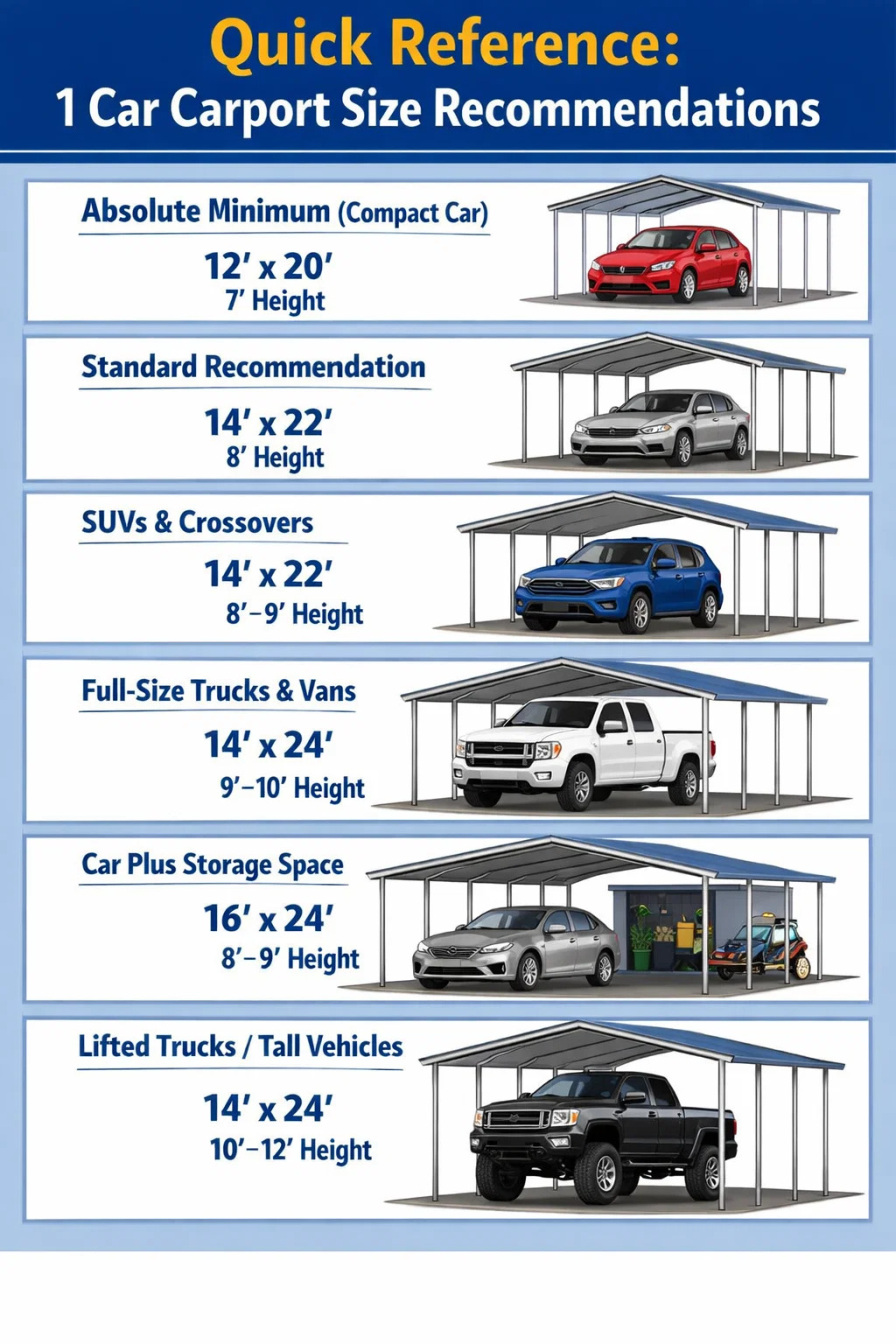
Quick Reference: 1 Car Carport Size Recommendations
Here's a final summary of the recommended sizes based on different situations:
- Absolute minimum (compact car, tight space): 12 ft × 20 ft, 7 ft height
- Standard recommendation (most passenger cars): 14 ft × 22 ft, 8 ft height
- SUVs and crossovers: 14 ft × 22 ft, 8–9 ft height
- Full-size trucks and vans: 14 ft × 24 ft, 9–10 ft height
- Car plus storage/workspace: 16 ft × 24 ft, 8–9 ft height
- Lifted trucks or tall vehicles: 14 ft × 24 ft, 10–12 ft height
When in doubt, go bigger rather than smaller. The cost difference between sizing up 2 feet in width or adding 2 feet of length to a steel carport is usually minor — often $50 to $150 — while the usability difference is substantial and permanent. A carport that's too small will bother you every single day; one that's slightly larger than needed never will.

 浙公网安备 33068302000509号