 English
 日本語
日本語 русский
 Español



Customer expresses intent; Communicate between the two parties; Provide analysis reports to customers; Reach a cooperation intention.
Content
- 1 What Does a Carport Actually Cost?
- 2 Does a Carport Add Value to Your Home?
- 3 Carport vs. Garage: Which Is the Better Investment?
- 4 The Real Financial Benefit: What a Carport Saves You
- 5 Carport ROI by Climate and Region
- 6 Does a Carport Affect Home Insurance?
- 7 Permits, HOA Rules, and What Can Derail a Carport Project
- 8 How to Maximize the Value of a Carport Investment
- 9 What Buyers Actually Think About Carports
- 10 Alternatives Worth Considering Before You Build
- 11 The Bottom Line on Carport Investment
Yes — for most homeowners, a carport is a good investment. It protects your vehicle, adds usable outdoor structure, and typically costs a fraction of what a garage would run you. Whether you recover that cost at resale depends on your local market, your property type, and how the carport is built. But in terms of day-to-day utility and upfront value, few home additions offer the same return per dollar spent.
That said, "good investment" means different things to different people. If you're asking whether a carport will pay for itself when you sell your home, the answer is nuanced. If you're asking whether it's worth building for the protection and convenience it offers right now, the answer is almost always yes — provided you choose the right type and have it installed properly.
This article walks through everything you need to know: upfront costs, long-term value, how carports compare to garages, what buyers actually think, and how to get the most out of the investment if you decide to move forward.
What Does a Carport Actually Cost?
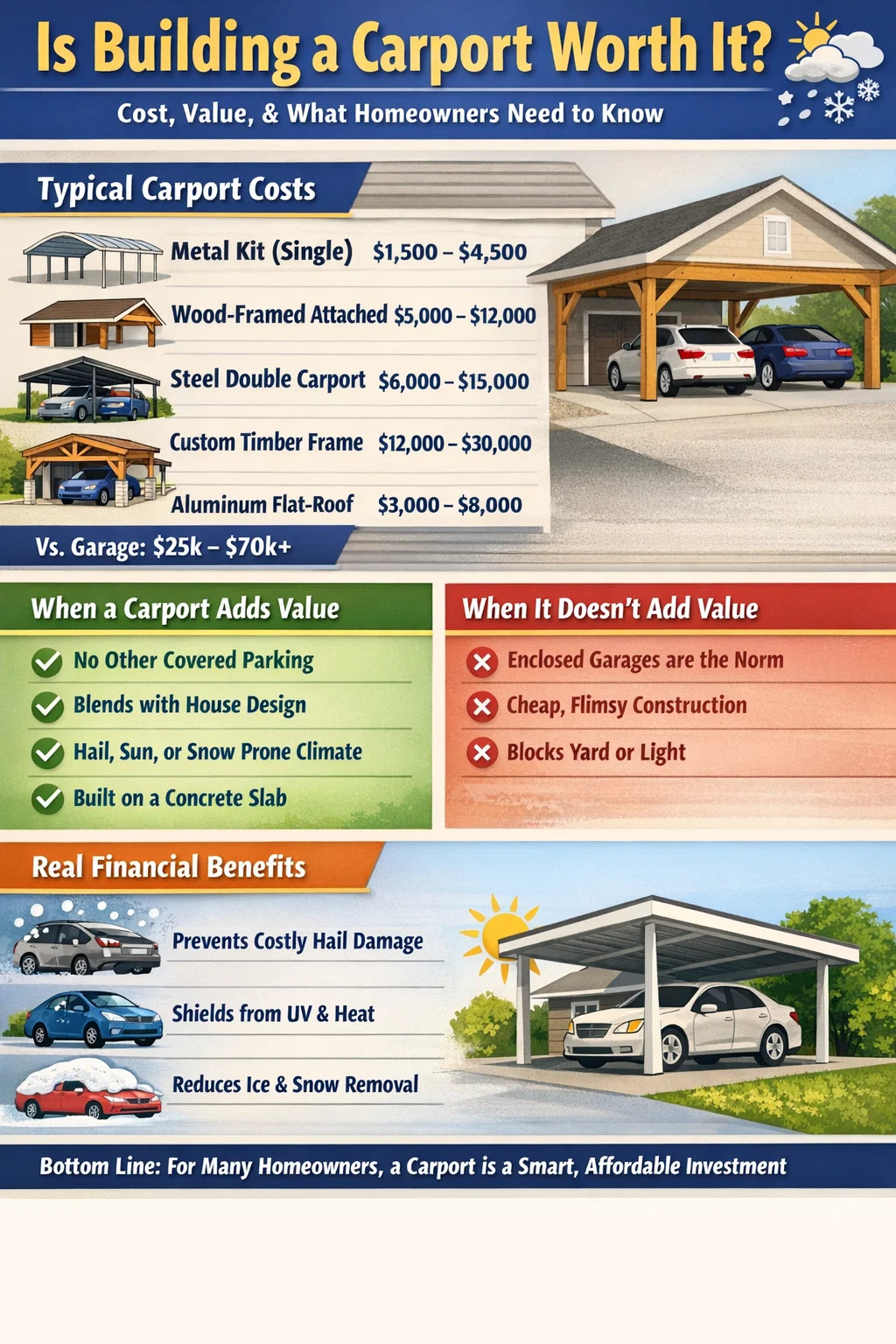
One of the biggest advantages of a carport over a garage is the cost gap. A standard attached or freestanding carport for a single vehicle typically runs between $3,000 and $8,000 installed. A double carport — wide enough for two vehicles side by side — usually falls in the $6,000 to $15,000 range depending on materials and whether a concrete slab is poured.
Compare that to a single-car detached garage, which averages $25,000 to $50,000 or more in most U.S. markets. An attached garage with proper framing, insulation, drywall, and a door can push $40,000 to $70,000 in higher-cost states. The carport is delivering the core benefit — shelter from sun, rain, hail, and bird droppings — at roughly 15% to 30% of the garage cost.
Breakdown by Carport Type
| Carport Type | Typical Cost (Installed) | Best For |
|---|---|---|
| Metal kit (single) | $1,500 – $4,500 | Budget-conscious buyers, rural properties |
| Wood-framed attached | $5,000 – $12,000 | Suburban homes, curb appeal |
| Steel double carport | $6,000 – $15,000 | Two-vehicle households |
| Custom timber frame | $12,000 – $30,000 | High-end properties, architectural match |
| Aluminum flat-roof | $3,000 – $8,000 | Modern homes, minimal maintenance |
Additional costs to factor in include permits (typically $200–$1,000 depending on your municipality), concrete slabs ($4–$8 per square foot), and electrical work if you want lighting or a charging outlet for an EV. Some jurisdictions require stamped engineering drawings for anything over a certain square footage or height — that can add $500 to $2,000 to the project.
Does a Carport Add Value to Your Home?
This is where homeowners often get confused, because the answer depends heavily on where you live and what local buyers expect. In markets where garages are standard — think suburbs across the Midwest, the Pacific Northwest, or New England — a carport may be seen as a downgrade, not an upgrade. In markets where covered parking is simply a bonus — sunbelt states, rural areas, properties with large lots — a carport can meaningfully improve a listing.
Real estate data suggests that covered parking in general adds roughly 1% to 5% to a home's resale value, with the higher end applying to markets where parking is scarce or outdoor vehicle protection is highly valued due to weather. In hot, hail-prone markets like Texas, Oklahoma, and Colorado, a carport can be a genuine selling point because it signals reduced vehicle maintenance costs for the buyer.
Appraisers generally treat carports as contributory value — meaning they add something, but not dollar-for-dollar what you spent. A $10,000 wood-framed double carport might contribute $4,000–$7,000 in appraised value improvement on a $350,000 home. That's not full cost recovery, but it's not zero either.
When a Carport Adds the Most Value
- The property has no other covered parking option
- The carport is attached to the house and architecturally cohesive
- The local climate makes vehicle protection highly desirable (hail, intense UV, heavy snow)
- The neighborhood has comparable properties with covered parking
- The carport is built on a concrete slab with proper permits pulled
When a Carport Adds Little or No Value
- The neighborhood standard is a full enclosed garage
- The carport is a cheap metal kit that looks temporary or out of place
- It was built without permits and may need to be disclosed or removed
- It blocks natural light into the home or reduces usable yard space significantly
- Local buyers are specifically looking for garage storage, which a carport doesn't provide
Carport vs. Garage: Which Is the Better Investment?
The garage vs. carport debate comes down to what you're optimizing for. If storage, security, and maximum resale appeal are the priority, a garage wins. If vehicle protection, speed of installation, and cost efficiency are what you're after, a carport is hard to beat.
A garage delivers enclosed, lockable space that can serve as storage, a workshop, a gym, or a home office. That versatility is significant and explains why garages consistently show higher ROI than carports in suburban resale markets. According to Remodeling Magazine's Cost vs. Value report, a mid-range garage addition recoups roughly 55% to 65% of its cost at resale — which sounds underwhelming, but on a $40,000 garage that's $22,000–$26,000 in added value, which is real money.
A carport may recoup a lower percentage of its cost in dollar terms, but its base cost is so much lower that the out-of-pocket gap still favors the carport for homeowners who don't need a fully enclosed structure. If you spend $7,000 on a well-built wood-frame carport and it adds $4,500 in home value while providing five to ten years of daily vehicle protection, that's a reasonable outcome.
Side-by-Side Comparison
| Factor | Carport | Garage |
|---|---|---|
| Average cost | $3,000–$15,000 | $25,000–$70,000 |
| Vehicle protection | Partial (no walls) | Full (enclosed) |
| Security | Low | High |
| Storage use | Minimal | Extensive |
| Permit complexity | Lower | Higher |
| Build time | 1–3 days | 2–8 weeks |
| Resale appeal | Market-dependent | Broadly positive |
| Maintenance | Low | Moderate to high |
The Real Financial Benefit: What a Carport Saves You
One of the most underappreciated aspects of the carport investment question is what you save rather than what you gain at resale. Vehicle protection has a direct, measurable financial impact that most homeowners don't account for when evaluating whether a carport is worthwhile.
UV and Heat Damage to Vehicles
Parking a vehicle in direct sunlight year-round accelerates paint oxidation, causes dashboard cracking, degrades rubber seals, and can warp interior plastics. Detailing costs to address sun damage range from $150 to $1,000+ depending on severity. A full paint correction on a vehicle with heavy UV oxidation can cost $1,500–$3,500. A carport essentially eliminates this ongoing cost entirely.
Hail Damage
In hail-prone states, this is the single most compelling financial argument for a carport. The average hail damage insurance claim in the United States runs approximately $4,000 to $8,000 per vehicle. Even one hail event can cost more than a mid-range carport. Homeowners in Texas, Colorado, Nebraska, Kansas, and Missouri who have experienced multiple hail seasons understand this calculus immediately.
Beyond the repair cost, insurance premiums can rise after claims. Some comprehensive auto policies carry deductibles of $500–$1,000 per vehicle. A family with two vehicles in a hail-active region could face $1,000–$2,000 in deductibles plus premium increases after a single storm — more than enough to justify a $6,000–$10,000 double carport over a few seasons.
Winter Ice and Snow
For homeowners in cold climates, a carport reduces the time spent scraping ice and clearing snow, keeps the engine and battery from experiencing extreme cold starts, and eliminates freeze damage to windshield wipers and rubber door seals. These aren't enormous individual costs, but the cumulative time savings and reduced wear add up across years.
EV Charging Convenience
If you own or plan to own an electric vehicle, a carport is a natural anchor point for a Level 2 home charger. Installing a 240V outlet under or adjacent to a carport typically costs $300–$800 and provides the infrastructure for home EV charging indefinitely. This is more convenient and often safer than running a cable through a window or across a driveway, and it adds practical value to the property as EV adoption continues to grow.
Carport ROI by Climate and Region
Where you live shapes the investment case for a carport more than almost any other variable. The same structure delivers very different levels of practical benefit depending on regional climate conditions.
High-ROI Regions for Carport Installation
- Texas, Oklahoma, Kansas: Hail risk is severe and frequent. A carport pays for itself after one or two prevented hail damage events.
- Arizona, Nevada, Southern California: Extreme UV and heat degrade vehicles rapidly. Covered parking is a meaningful selling point in real estate listings.
- Florida, Gulf Coast: Sun and humidity combined accelerate paint and mechanical wear. Storm season also creates demand for overhead protection.
- Mountain West (Colorado, Wyoming, Montana): Hail and heavy snow loads both relevant. A properly engineered carport with snow load rating is a practical necessity on some properties.
Lower-ROI Regions (Practically Speaking)
- Pacific Northwest: Mild temperatures reduce urgency. Rain matters but doesn't damage vehicles the way hail or UV does. Buyers may prefer a garage if they want covered parking at all.
- Northeast (New York, New England): Garage culture is strong. Carports are less common and buyers in these markets tend to see them as an incomplete solution.
- Upper Midwest: Deep snow and sub-zero temperatures make an enclosed garage more appealing than a carport for true year-round protection.
Does a Carport Affect Home Insurance?
A permanently installed carport that is attached to or part of your home's structure is typically covered under your homeowner's insurance as a "permanent structure" or "other structure." This means it's protected against damage from storms, fire, and other covered perils — usually for 10% of your home's dwelling coverage by default under standard HO-3 policies.
However, freestanding metal kit carports may be treated differently. Some insurers consider them temporary structures or personal property, which means they receive less coverage or are excluded from certain claim types. Before installation, it's worth a quick call to your insurer to confirm how the new structure will be classified and whether you need to adjust your "other structures" coverage limit.
Adding a carport won't typically increase your premium significantly unless it's a very high-value custom structure. In some cases, insurers may require updated photos or documentation of the build. Building with permits simplifies this process considerably.
Permits, HOA Rules, and What Can Derail a Carport Project
This is the part that catches homeowners off guard. A carport that looks simple from the outside can involve a surprising amount of regulatory friction before the first post goes in the ground.
Permits
Most municipalities require a building permit for any permanent structure over a certain size — often 120 or 200 square feet, though this varies. Permit fees typically range from $200 to $1,000 and the process may require submitting site plans, structural drawings, and scheduling an inspection. Skipping permits is a serious mistake: unpermitted structures can complicate home sales, trigger fines, and in some cases require removal.
Setback Requirements
Zoning codes establish minimum setback distances from property lines, easements, and sometimes from the primary dwelling itself. A carport that sits too close to a neighbor's property may not be approvable regardless of how well it's built. Check setback requirements before purchasing materials or hiring a contractor.
HOA Restrictions
Homeowners associations in many suburban neighborhoods place strict controls on what structures can be added and how they must look. Some HOAs prohibit freestanding carports entirely. Others require that any covered parking structure match the existing home's roofline, materials, and color. Approval from an HOA architectural review committee can take weeks and may come with conditions that add cost.
If you're in an HOA, read your CC&Rs carefully before assuming a carport is an option. Fighting an HOA over an unapproved structure is expensive and stressful — and you will almost certainly lose.
Snow Load and Wind Ratings
In regions with heavy snowfall or high wind zones, building codes require that structures meet minimum load ratings. A cheap metal kit carport designed for mild climates may not pass inspection in a jurisdiction with stringent snow or wind requirements. Engineering a carport to code in a high-load environment adds cost but is non-negotiable for safety and legal compliance.
How to Maximize the Value of a Carport Investment
If you've decided a carport makes sense for your situation, the way you build it has a significant impact on how much value it generates — both in daily use and in eventual resale.
Choose Materials That Match the Home
A galvanized steel kit carport attached to a craftsman bungalow sends a negative signal to buyers. A wood-framed carport with matching trim colors, the same roofing material, and complementary proportions reads as an intentional part of the home. The difference in resale impact between a cohesive and a mismatched carport can be substantial — in some cases the difference between adding value and reducing curb appeal.
Pour a Concrete Slab
Gravel or bare dirt under a carport looks unfinished and creates drainage and mud problems. A concrete slab costs $1,500–$4,000 depending on size but dramatically improves the structure's appearance, durability, and perceived permanence. Appraisers and buyers both respond better to a carport on a proper concrete pad.
Pull the Permits
As mentioned above, permitted structures integrate cleanly into home disclosures, appraisals, and sales. Unpermitted work introduces legal and financial risk that far outweighs the short-term savings of skipping the process. This is not optional advice — it's a baseline requirement for a smart investment.
Add Functional Details
Lighting, a 240V outlet for EV charging, gutters that connect to the home's drainage system, and storage hooks or ceiling tracks all increase the carport's utility without dramatically increasing cost. These additions make the space feel more complete and are often highlighted in real estate listings as practical features.
Size It Generously
A carport that fits today's vehicle but barely clears the mirrors or requires perfect parking technique is frustrating to use. Build to at least 12 feet wide per vehicle bay and a minimum of 20 feet deep. If budget allows, 14 feet wide per bay accommodates trucks and SUVs without stress. Going slightly larger adds modest cost but significantly improves day-to-day usability.
What Buyers Actually Think About Carports
Buyer perception is more nuanced than "carport good" or "carport bad." The reaction largely depends on what the buyer was already expecting and whether the carport signals intentionality or compromise.
In markets where carports are common — much of the American South, rural properties across the West, and many neighborhoods in sunbelt states — buyers treat covered parking as a straightforward amenity. A property with a carport beats a comparable one without any covered parking, and the listing agent knows it.
In markets where garages dominate, buyers looking at a home with only a carport often mentally subtract money for the cost of converting it or eventually building a garage. This doesn't mean carports are deal-breakers, but it does mean the value contribution is lower than the builder might expect.
First-time buyers and those on tighter budgets tend to view carports more favorably — they want functional covered parking and aren't prioritizing the enclosed storage a garage provides. Move-up buyers and buyers with multiple vehicles, tools, or recreational equipment tend to see a garage as a necessity, not a luxury.
Alternatives Worth Considering Before You Build
A carport is not always the right answer. Depending on your situation, one of these alternatives might serve you better or complement a carport installation.
Portable Canopy or Car Tent
For renters or homeowners in HOA neighborhoods that prohibit permanent structures, a heavy-duty portable canopy ($200–$800) offers UV and rain protection without a permit or footings. It won't survive major storms or add any resale value, but it solves the immediate vehicle protection problem cheaply.
Car Cover
A quality fitted car cover ($150–$500) protects against UV, bird damage, and light hail. It's not practical for daily drivers because putting on and removing a cover every day gets old quickly, but for a seasonal or collector vehicle it's a cost-effective alternative to covered parking.
Porte-Cochere or Extended Roof Overhang
If you're doing a broader home renovation, adding a deep roof overhang over the driveway can provide meaningful vehicle protection and architectural interest without the visual presence of a carport. This works particularly well on ranches or craftsman-style homes where wide overhangs fit the design language.
Full Garage Conversion or Addition
If you have a covered but open carport that came with the house and want to enclose it, converting a carport to a garage is often significantly cheaper than building a garage from scratch — typically $7,000 to $25,000 depending on the existing structure. This path gives you the security and storage of a garage without starting from zero.
The Bottom Line on Carport Investment
A carport is a good investment for most homeowners who need covered vehicle parking and aren't in a position to build — or don't need — a full enclosed garage. The upfront cost is manageable, the protection value is real and measurable, and when done right, it adds genuine appeal to a property.
It is not a replacement for a garage in markets where garages are expected. It will not recoup its full cost at resale in most cases. And a cheap, poorly installed carport that looks out of place can actually hurt a home's curb appeal rather than help it.
The homeowners who get the most out of a carport investment are those who build it properly, match it to the home's architecture, pull the necessary permits, and choose the right size and material for their climate. Done that way, a carport isn't just a cover over your car — it's a practical, cost-effective structure that delivers daily value and positions the property well for future buyers.
If you're on the fence, the clearest question to ask yourself is this: how much would one hail event, one year of UV damage, or one season of ice-scraping cost you? For most vehicle owners, the math points firmly toward yes.

 浙公网安备 33068302000509号