 English
 日本語
日本語 русский
 Español




Customer expresses intent; Communicate between the two parties; Provide analysis reports to customers; Reach a cooperation intention.
Content
- 1 What a Carport Actually Is — And What It Includes
- 2 Why Most Carports Don't Have Doors
- 3 Carport vs. Garage: A Direct Comparison
- 4 Types of Carports and Whether Any Come With Doors
- 5 Can You Add a Door to an Existing Carport?
- 6 Security Implications of a Doorless Carport
- 7 How a Carport With Side Panels Differs From a Door-Equipped One
- 8 When a Carport With a Door Makes Sense
- 9 Carport Conversion to Garage: Full Enclosure With a Door
- 10 Summary: Key Facts About Carports and Doors
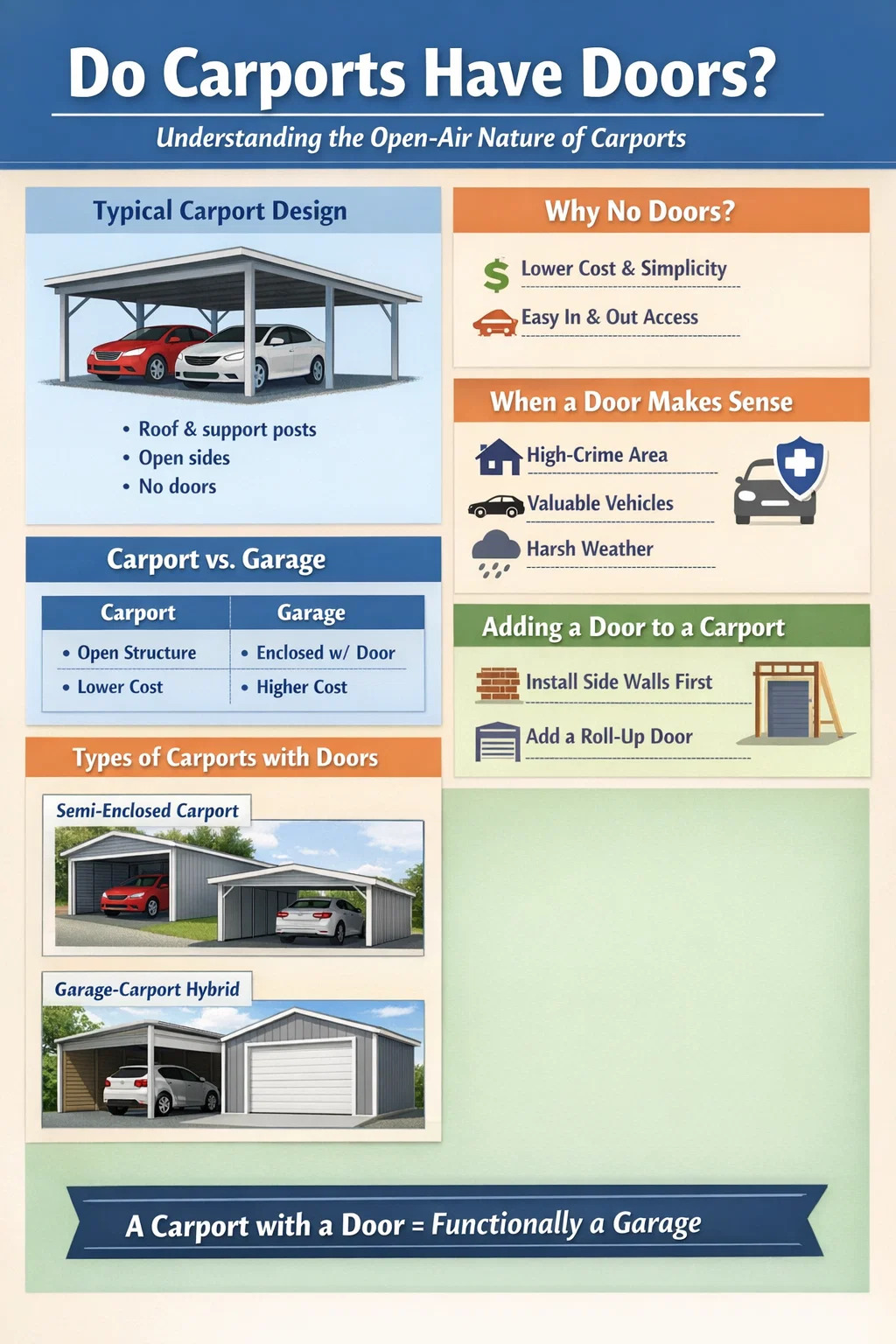
No, a standard carport does not have a door. Unlike a garage, a carport is an open or semi-open structure designed to shelter vehicles from rain, sun, and debris without enclosing them behind a door or wall. That said, some carport designs do incorporate side panels, privacy screens, or even retrofit door systems — so the answer depends heavily on the type of carport you choose or build.
This distinction matters when homeowners are deciding between a carport and a garage, planning a new structure, or considering upgrades to an existing carport. Below, this guide breaks down everything you need to know: what carports typically include, why most lack doors, when doors make sense, and how to modify a carport if you want more security or enclosure.
What a Carport Actually Is — And What It Includes
A carport is a covered, partially or fully open structure attached to or detached from a home, used primarily to protect one or more vehicles from the elements. The defining characteristic of a carport is its open-air design — it typically has a roof supported by posts or columns but lacks full walls or doors.
Standard carports usually include:
- A roof structure (metal, polycarbonate, timber, or fabric)
- Support posts or columns (steel, aluminum, or wood)
- A concrete, asphalt, or gravel floor
- Open sides on at least two or three faces
What they almost never include by default: walls on all four sides, locking doors, or automated entry systems. This is where carports differ fundamentally from garages. A typical single-car garage has a large motorized door, often 8–9 feet wide and 7–8 feet tall, along with fully enclosed walls. A carport simply does not offer that by default.
Carport sizes commonly range from a single-bay width of about 12 feet for one car to 20–24 feet wide for a double carport. The roof height is typically 7 to 9 feet to accommodate SUVs and trucks. None of these standard dimensions include space allocated for a door frame or door mechanism.
Why Most Carports Don't Have Doors
The open design of a carport is not an oversight — it's intentional. Several practical and economic reasons explain why doors are not a standard feature:
Cost and Simplicity
Carports are popular partly because they are much cheaper than garages. A basic metal carport kit can cost as little as $1,000–$3,500, while a professionally installed single-car garage typically runs $20,000–$50,000 or more. Adding a door structure, frame, hardware, and installation can add $1,500–$5,000+ to any project. For homeowners seeking affordable vehicle protection, avoiding a door keeps costs down significantly.
Easier Access and Convenience
Open-sided carports allow vehicles to pull in and out from multiple directions without the need to open or close a door. This is especially useful in properties with limited turning radius, or for households with multiple drivers. A door adds a step — and a potential failure point — to what is supposed to be a simple parking solution.
Zoning and Permit Requirements
In many municipalities, a structure becomes classified as a "garage" — and therefore subject to stricter building codes and permit requirements — once it has fully enclosed walls and a door. By keeping carports open, homeowners often avoid more complex permitting processes. In some areas, a basic carport does not require a permit at all, while adding walls and a door can trigger full structural review.
Ventilation and Airflow
Open carports naturally vent exhaust fumes, moisture, and heat. An enclosed structure requires intentional ventilation design. For properties in warm climates especially, an open-sided carport keeps vehicles cooler and avoids the heat buildup common in sealed garages during summer months.
Carport vs. Garage: A Direct Comparison
Understanding the difference between a carport and a garage helps clarify why the door question matters so much to buyers and builders alike.
| Feature | Carport | Garage |
|---|---|---|
| Door | Usually none | Yes (standard) |
| Walls | Open or partial | Fully enclosed |
| Average Cost (single car) | $1,000–$6,000 | $20,000–$50,000+ |
| Security Level | Low | High |
| Permit Requirements | Often minimal | Full permit typically required |
| Weather Protection | Moderate (roof only) | Full |
| Additional Storage Use | Limited | High |
The most important takeaway from this comparison is that a carport is fundamentally an open shelter, not an enclosed storage unit. If your primary goal is vehicle security, theft prevention, or fully weatherproof storage, a garage with a door is the right choice.
Types of Carports and Whether Any Come With Doors
Not all carports are identical. There are several common carport styles, and a small number of them do incorporate door-like features. Here is a breakdown:
Attached Carports
These are built against the side of a house and share one wall with the home. They typically have one enclosed side (the house wall) and three open sides. No door is standard, though some homeowners add a side panel or gate for privacy. In some cases, a door connecting the carport interior to the house exists — but this is a house entry door, not a carport door.
Freestanding or Detached Carports
Fully standalone structures with open sides on all four faces. These are among the most common carport types sold as kits. They have no walls, no doors, and no enclosure whatsoever. Examples include the popular metal carport kits from brands like Arrow, Palram, or ShelterLogic, all of which are sold as open structures.
Enclosed Carports (Semi-Enclosed)
Some structures marketed as "enclosed carports" or "carport with walls" feature side panels on two or three sides, leaving one end open for vehicle entry. These are sometimes sold with an optional roll-up door or sliding panel for the open end. This is the one carport type that can legitimately have a door, though it blurs the line between a carport and a garage. Products in this category, like the Palram-Canopia carport range, offer optional end-wall kits with roll-up doors.
Canopy-Style Carports
These are simple fabric or polycarbonate roof shelters supported by four corner poles. They are entirely open on all sides and never come with doors. Often used as temporary or portable solutions, canopy carports offer the least enclosure of any carport type.
Garage-Carport Hybrids
Some prefabricated steel building companies offer hybrid structures that look like carports but can be ordered with full wall panels and a roll-up garage door. These are essentially prefab garages marketed under the carport label. If you see a "metal carport with door" listed for sale, you are likely looking at this hybrid category. Prices for these range from $4,000 to $15,000 installed, depending on size and features.
Can You Add a Door to an Existing Carport?
Yes, it is possible to add a door to an existing carport, but it requires planning and potentially permits. The process varies based on your carport's existing structure, material, and local building codes. Here are the most common approaches:
Adding a Roll-Up Door
A roll-up door (manual or motorized) can be fitted to the open front of a carport if the structure is sufficiently rigid and has a header beam strong enough to support the door tracks. Manual roll-up doors for a 10-foot-wide opening start around $300–$600, while motorized options with openers typically run $800–$2,500 for the door alone, plus installation labor. A carport's lightweight post-and-beam structure may need reinforcement before a door can be properly mounted.
Installing Side Walls First
Before adding a door, most carport conversions require installing at least partial side walls to create an enclosed bay. Metal wall panels, timber framing, or prefab wall sections can be added to an existing steel carport frame. Without side walls, a door at the front would not meaningfully improve enclosure or security.
Using a Fabric or Mesh Curtain Door
For a simpler, non-permanent solution, fabric curtain-style carport doors (also called carport enclosure kits) can be zippered or velcro-attached across the open front of a carport. These do not provide structural security but do reduce wind, rain, and debris intrusion. Products like the ShelterLogic carport enclosure kit are widely available for $50–$200 and fit most standard carport widths.
Building Permit Considerations When Adding a Door
Once you add walls and a door to a carport, you are effectively converting it into a garage in the eyes of most building departments. This can trigger a permit requirement, an inspection, and potentially increased property taxes because the structure's assessed value increases. Before starting any carport enclosure project, contact your local planning or building department to understand the requirements in your specific jurisdiction.
Security Implications of a Doorless Carport
One of the most common reasons homeowners ask whether a carport has a door is security. Without a door, a carport provides very limited protection against vehicle theft, break-ins, or theft of items stored inside.
According to the FBI's crime data, motor vehicle theft in the United States has increased significantly in recent years, with over 1 million vehicles stolen in 2022 — the highest number in nearly two decades. A vehicle parked in an open carport is considerably more accessible to thieves than one locked inside a garage with a secured door.
However, there are practical security measures carport owners can take:
- Motion-sensor lighting: Bright lights activated by motion deter opportunistic theft, particularly at night.
- Security cameras: Visible CCTV or smart cameras (like Ring or Arlo) act as deterrents and provide evidence in case of an incident.
- Steering wheel locks: Physical anti-theft devices like the Club remain effective deterrents even in open parking structures.
- GPS trackers: Devices like Apple AirTag or dedicated vehicle GPS trackers help recover stolen vehicles.
- Carport gates or barriers: A driveway gate or retractable bollard in front of the carport adds a meaningful physical obstacle.
None of these fully replicate the security of a locked garage door, but combined they can significantly reduce risk for carport users.
How a Carport With Side Panels Differs From a Door-Equipped One
Some carports are sold with optional side panels or privacy walls — but this is not the same as having a door. Side panels fill in the open sides of a carport, reducing wind, rain, and visibility from the street. They do not open and close like a door and do not lock.
Common materials used for carport side panels include:
- Corrugated metal sheeting
- Polycarbonate panels (translucent for light transmission)
- Timber slat fencing
- Lattice or privacy screen panels
These side panels can make a carport feel more enclosed and offer better weather protection on windy days, but they do not convert the carport into a garage-level secure structure. A carport with side panels on three sides and an open front face is still, by definition, a carport without a door.
The moment a functioning door — one that opens, closes, and can be locked — is added to the open face, the structure functionally becomes what most building codes classify as an enclosed garage.
When a Carport With a Door Makes Sense
Despite the norm of doorless carports, there are specific situations where adding a door — or choosing an enclosed carport design from the start — is the smarter choice:
High-Crime Neighborhoods
If you live in an area with above-average vehicle theft rates, an enclosed carport with a lockable roll-up door provides a meaningful level of deterrence. Even a basic manual roll-up door requires tools and effort to breach, which is enough to deter many opportunistic thieves.
Storing High-Value Vehicles
Classic cars, motorcycles, boats, or recreational vehicles that are not in daily use benefit more from enclosed storage. For owners who cannot afford a full garage build, an enclosed carport with a door offers a middle-ground solution at a fraction of the cost.
Severe Weather Regions
In areas prone to hail, high winds, sandstorms, or extreme snow, an enclosed carport with a door provides full protection that an open carport simply cannot. Hail damage claims average $4,300 per vehicle according to insurance industry data — a strong financial argument for full enclosure in hail-prone states like Texas, Colorado, and Nebraska.
HOA Restrictions or Neighborhood Aesthetics
Some homeowners associations require that vehicles be stored out of sight. An enclosed carport with a door satisfies this requirement more effectively than an open carport, without requiring the expense of a full garage construction.
Carport Conversion to Garage: Full Enclosure With a Door
One of the most popular home improvement projects in the United States is converting an existing carport into a fully enclosed garage. This project addresses the door question head-on by transforming an open shelter into a secure, enclosed space.
A typical carport-to-garage conversion involves:
- Evaluating the existing carport structure for suitability (foundation, roof load, column placement)
- Framing in the open sides with stud walls
- Installing drywall or exterior siding on the new walls
- Cutting a rough opening and installing a garage door and header
- Adding electrical wiring for lighting and a garage door opener
- Insulating and finishing the interior if desired
The average cost of converting a carport to a garage ranges from $5,000 to $22,000, depending on size, materials, and whether the existing structure requires significant reinforcement. This is substantially less than building a new garage from scratch, which is why carport conversions are a popular renovation choice.
From a return-on-investment perspective, converting a carport to a garage can add meaningful resale value to a home. Real estate data suggests that an attached garage can increase a home's value by $12,000–$30,000, depending on the market — making it a project that often pays back a significant portion of its cost.
Summary: Key Facts About Carports and Doors
- Standard carports do not have doors. They are open or semi-open structures designed for covered but accessible vehicle parking.
- The absence of a door is intentional — it reduces cost, simplifies access, and often avoids complex permitting requirements.
- Some carport types — specifically enclosed carports and garage-carport hybrids — can come with a roll-up or sliding door as a factory option.
- A door can be retrofitted to an existing carport, but typically requires side wall installation, structural reinforcement, and local permits.
- Once a carport has enclosed walls and a door, it is functionally and legally treated as a garage in most jurisdictions.
- Full conversion from carport to garage costs between $5,000 and $22,000 and can significantly increase home value.
- For security without full enclosure, motion lighting, cameras, and physical vehicle locks are practical intermediate measures.

 浙公网安备 33068302000509号