 English
 日本語
日本語 русский
 Español


Customer expresses intent; Communicate between the two parties; Provide analysis reports to customers; Reach a cooperation intention.
Content
- 1 What a 20x20 Carport Gets You
- 2 20x20 Carport Cost by Material Type
- 3 Full Cost Breakdown for a 20x20 Carport
- 4 Foundation Options and Their Impact on Price
- 5 Roof Style and How It Affects the Cost of a 20x20 Carport
- 6 Labor Costs: DIY vs. Professional Installation
- 7 Permit Costs and What They Cover
- 8 Optional Add-Ons and Upgrade Costs
- 9 How Location Affects 20x20 Carport Installation Cost
- 10 Prefab Kit vs. Custom Build: Which Is the Better Value?
- 11 Does a 20x20 Carport Add Value to Your Home?
- 12 Tips for Reducing the Cost of Your 20x20 Carport
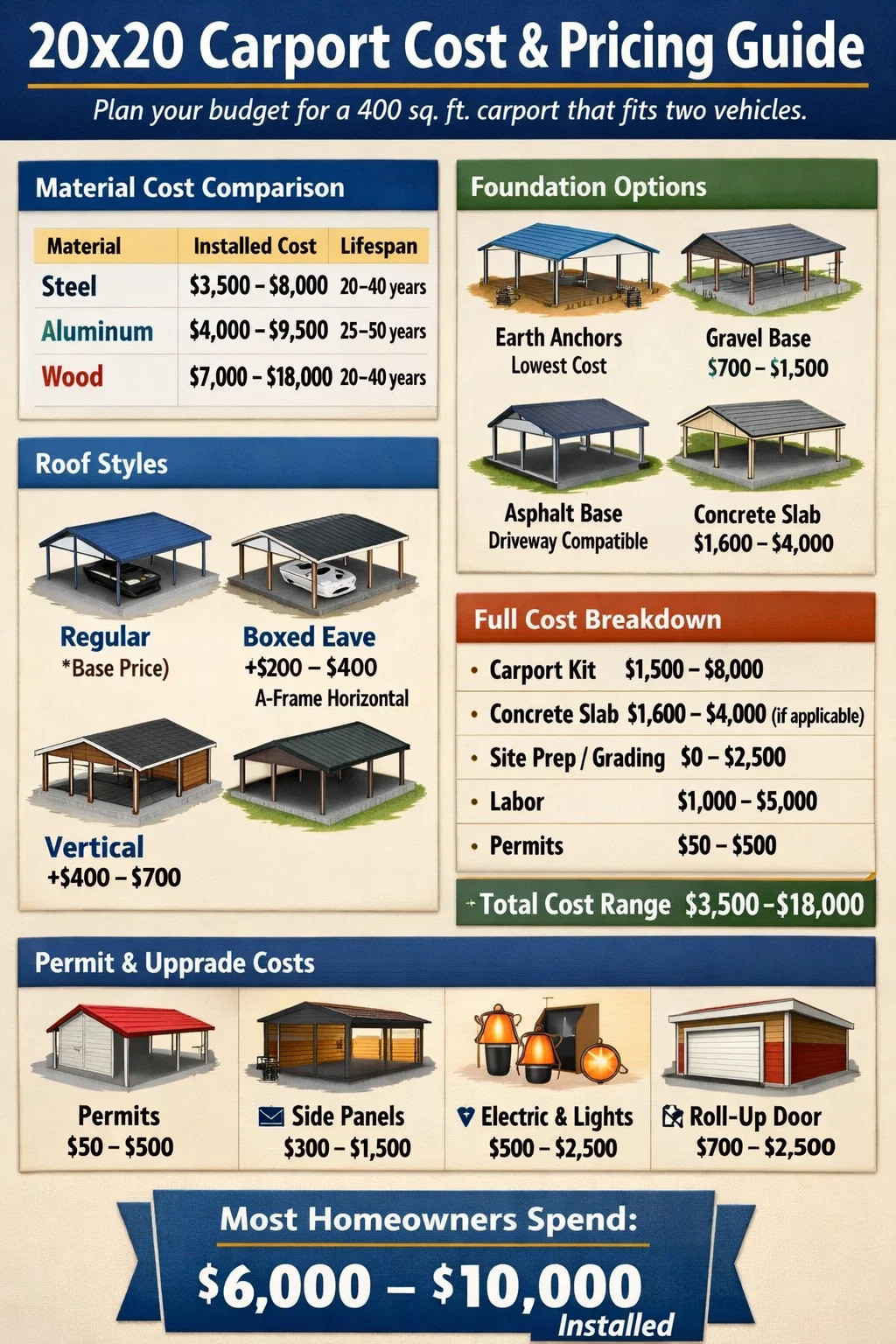
Installing a 20x20 carport costs between $3,500 and $18,000 in total, with most homeowners spending around $6,000–$10,000 for a professionally installed two-car carport. The wide range reflects differences in material type (wood, steel, or aluminum), whether you choose a prefabricated kit or custom build, local labor rates, site preparation needs, and permit fees. A basic steel kit carport on flat ground at the low end can come in under $4,000 installed, while a custom wood carport with a shingled roof and concrete slab can push well past $15,000. This guide breaks down every cost factor so you can plan your 20x20 carport budget accurately.
What a 20x20 Carport Gets You
A 20x20 carport covers 400 square feet of ground area. That's enough for two standard vehicles parked side by side, with roughly 8–9 feet of width per car and a little clearance between them. It also provides adequate clearance for taller vehicles like SUVs, pickup trucks, and minivans, as long as the carport's height — typically 7 to 12 feet at the eaves — is selected appropriately.
Beyond parking, a 20x20 footprint is popular for dual-use purposes: one parking bay and one workspace or storage area. Many homeowners use part of the covered space for lawn equipment, motorcycles, or outdoor gear storage while still parking one vehicle underneath.
Standard carport height options include:
- Regular height (7 ft legs): Suitable for most passenger cars and smaller SUVs.
- A-frame vertical (9–10 ft legs): Better clearance for trucks and vans; improved snow and water runoff.
- Vertical roof with 12 ft legs: Needed for RVs, camper vans, or commercial vehicles.
Choosing the right height upfront avoids costly modifications later. If you own a full-size pickup with a bed cap or a lifted vehicle, go with at least 9-foot legs.
20x20 Carport Cost by Material Type
Material selection is the biggest single variable in carport pricing. Here is how the three primary material options compare for a 20x20 structure, including both materials and typical installation labor.
| Material | Kit / Materials Cost | Installed Total (Est.) | Lifespan |
|---|---|---|---|
| Steel (prefab kit) | $1,500 – $4,500 | $3,500 – $8,000 | 20–40 years |
| Aluminum (prefab kit) | $2,000 – $5,500 | $4,000 – $9,500 | 25–50 years |
| Wood (custom build) | $3,500 – $8,000 | $7,000 – $18,000 | 20–40 years (with maintenance) |
Steel Carports
Steel is the most affordable and fastest option for a 20x20 carport. Prefabricated steel carport kits come with pre-punched holes, pre-cut framing, and hardware — a two-person crew can often assemble the structure in a single day. Popular kit suppliers like Carport.com, Alan's Factory Outlet, and Arrow Storage Products sell 20x20 steel carport kits for $1,800 to $3,800 before delivery. Delivery charges vary by distance but typically run $150–$500.
Steel carports are available in several roof styles: regular (rounded corners), boxed eave (flat horizontal trim), and vertical (ridgeline runs the length of the carport). Vertical roof steel carports cost $300–$700 more than regular style but shed rain and snow far more effectively and are worth the upgrade in any area with significant precipitation.
Aluminum Carports
Aluminum carports cost slightly more than steel but offer a key advantage: they never rust. This makes aluminum the preferred material for coastal climates, high-humidity regions, and anywhere with road salt exposure. A 20x20 aluminum carport kit from suppliers like SummerCasita or Palram runs $2,200 to $5,000 for materials. Installation typically takes one to two days.
Aluminum is lighter than steel, which simplifies handling during installation but also means aluminum structures have a lower maximum snow load rating. In areas with heavy snowfall, verify that any aluminum kit you purchase is rated for your local snow load requirements — typically found in your jurisdiction's building code.
Wood Carports
Wood carports are the most expensive option but also the most visually appealing. A pressure-treated lumber carport can be painted or stained to match your home's exterior precisely, and the structure blends far more naturally with residential architecture than metal kits. The tradeoff is cost and maintenance — wood needs repainting or restaining every 4–7 years and is susceptible to rot if flashing and drainage are not properly managed.
For a custom-built wood carport measuring 20x20 feet with a shingled roof, expect to pay $7,000–$18,000 total depending on design complexity, local lumber prices, and contractor labor rates. In high-cost states like California or New York, the upper end of that range is common.
Full Cost Breakdown for a 20x20 Carport
The total price of installing a 20x20 carport involves more than the structure itself. Site preparation, foundation work, permits, and optional upgrades all factor into the final bill. Here is a detailed breakdown of each cost component.
| Cost Component | Typical Range | Notes |
|---|---|---|
| Carport kit or framing materials | $1,500 – $8,000 | Steel kits on the low end; custom wood on the high end |
| Roofing material | $400 – $2,500 | Metal panels cheapest; asphalt shingles mid-range; polycarbonate variable |
| Concrete slab (if applicable) | $1,600 – $4,000 | 400 sq ft at $4–$10/sq ft; gravel base is cheaper at $500–$1,200 |
| Concrete footings / anchors | $200 – $800 | More footings needed in frost-prone areas |
| Site preparation / grading | $0 – $2,500 | Flat sites may need minimal prep; sloped sites require grading |
| Labor (installation) | $1,000 – $5,000 | Steel kit install cheaper; custom wood build most expensive |
| Building permit | $50 – $500 | Varies widely by municipality; some jurisdictions waive for open structures |
| Delivery of kit / materials | $150 – $600 | Distance from supplier affects freight cost |
| Total (typical range) | $3,500 – $18,000 | Most homeowners spend $6,000–$10,000 |
Foundation Options and Their Impact on Price
The foundation your 20x20 carport sits on has a significant impact on the total project cost and long-term durability. There are four main options, ranging from basic dirt anchors to a full concrete slab.
Earth Anchors (No Foundation)
The cheapest option. Earth anchors screw into the ground and attach to the carport's base plates. This approach is often included with basic steel kits and costs virtually nothing extra. The downside is that earth anchors perform poorly in strong winds, particularly in sandy or loose soil. Some jurisdictions won't approve permits for carports with earth anchors as the only anchoring method.
Gravel Base with Concrete Footings
A popular mid-range option. Concrete footings (typically 10–12 inches in diameter and 24–48 inches deep) are poured at each post location, and the rest of the area is filled with compacted gravel. This provides solid anchoring, good drainage, and a driveable surface without the cost of a full slab. Expect to pay $700–$1,500 for footings and a compacted gravel base on a 20x20 carport footprint.
Asphalt Base
If your carport extends from an existing asphalt driveway, you may be able to anchor posts directly through the asphalt into the subbase using anchor bolts. This avoids re-surfacing costs but requires a sufficiently thick asphalt base (at least 3–4 inches) and proper anchor sizing. Asphalt is not as rigid as concrete and may shift over time in extreme temperatures.
Full Concrete Slab
A 20x20 concrete slab is the most durable and versatile foundation, especially if you plan to convert the carport into a garage later. At $4–$10 per square foot for a 4-inch reinforced slab, a 400-square-foot slab runs $1,600–$4,000. Adding a 6-inch slab with rebar for heavier vehicle loads increases cost to $2,500–$5,500.
Concrete slabs take 28 days to reach full cure strength, though they can be used for light vehicle traffic within 7 days. Factor this curing time into your project schedule if you need the carport operational quickly.
Roof Style and How It Affects the Cost of a 20x20 Carport
For steel and aluminum carports, roof style is one of the most impactful variables on both price and performance. Three standard styles are offered by most kit manufacturers.
| Roof Style | Price Premium vs. Regular | Best For |
|---|---|---|
| Regular (rounded corners) | Base price | Mild climates with low rain/snow |
| Boxed eave (A-frame horizontal) | +$200 – $400 | Better appearance; moderate rain areas |
| Vertical (A-frame vertical panels) | +$400 – $700 | Heavy rain, snow, or high-wind areas |
The vertical roof style is worth the price premium for most buyers. Its panels run vertically (parallel to the end walls) rather than horizontally, which means debris, rain, and snow slide off immediately instead of accumulating. In areas with more than 20 inches of annual snowfall, the vertical roof is practically essential to prevent panel damage and structural stress.
For wood carports, you have complete flexibility in roof design. Options include a simple shed roof (single slope), a gable roof (peaked center ridge), or a hip roof. Gable roofs cost 15–25% more than shed roofs due to the added framing complexity but are more visually proportionate on a 20x20 structure.
Labor Costs: DIY vs. Professional Installation
Labor typically accounts for 30–50% of the total carport installation cost. The amount you pay depends on whether you install the structure yourself, use a contractor, or order a kit with included installation from the supplier.
DIY Installation
A steel or aluminum 20x20 carport kit is genuinely doable as a DIY project for someone with basic construction skills and one or two helpers. Most kits include detailed instructions and all hardware. A realistic time estimate for a first-time installer is two to three full days for a steel kit on a prepared surface. You save $1,000–$3,000 in labor but take on all the physical work and liability for incorrect installation.
Key tools you'll need: a concrete drill, impact driver, level, tape measure, and a two-person lifting setup for the roof panels. Some kits require a ladder and a willingness to work at height during roof panel installation.
Contractor or Supplier-Installed
Many steel carport suppliers offer installation as an add-on service. Some, like Carport.com and Alan's Factory Outlet, include installation in the quoted price depending on your region. When purchased this way, a 20x20 steel carport installed by the supplier typically runs $3,500–$6,500 total — materials, delivery, and labor bundled together.
For wood carports, you'll need to hire a local general contractor or carpenter. Expect labor rates of $50–$100 per hour depending on your region. A skilled two-person crew typically completes a wood 20x20 carport in 3–5 days, translating to $2,400–$5,000 in labor alone.
When to Always Hire a Professional
Certain situations make professional installation non-optional: attaching the carport to a house (ledger board installation requires proper flashing expertise), building on a sloped or uneven site, pouring a new concrete slab, or working in jurisdictions that require licensed contractors for permitted structures. Mistakes in these areas are expensive — a poorly installed ledger board can cause water infiltration that rots out a wall cavity in just a few years.
Permit Costs and What They Cover
Building permits for a 20x20 carport range from $50 to $500 depending on your municipality. Most jurisdictions require a permit for any permanent structure, including freestanding and attached carports. Some areas waive permit requirements for open-sided structures below a certain square footage — but this varies widely, so always confirm with your local building department before assuming you're exempt.
Permit fees typically cover plan review and one or more inspections during construction. Inspections usually check footing depth and concrete pour, structural anchoring, and sometimes electrical if you're adding lighting or outlets. In some jurisdictions, an engineer's letter is required for any structure larger than 200 square feet — this can add $300–$800 to your costs.
Skipping a required permit is not worth the risk. Unpermitted carports can trigger fines, forced removal orders, or complications when you sell or refinance your home. A buyer's home inspector will flag the structure, and the lender or buyer may require retroactive permits or demolition as a condition of closing.
Optional Add-Ons and Upgrade Costs
A basic 20x20 carport kit gives you a roof and posts. Many homeowners add features that improve functionality, security, or appearance. Here is what common upgrades cost:
- Side panels or privacy walls: $300–$1,500 depending on material (metal panels, polycarbonate, or wood lattice) and how many sides are enclosed.
- Electrical wiring and lighting: $500–$2,500 for running a circuit from your main panel to the carport, installing outlets, and mounting weatherproof fixtures.
- Gutter and downspout system: $200–$600 to channel rainwater away from the structure and surrounding area.
- Roll-up or sliding door (if enclosing): $700–$2,500 for a standard single 9-foot roll-up door; $1,500–$4,000 for a double 16-foot door.
- Polycarbonate roof panels instead of metal: Adds $400–$1,200 to material cost but lets natural light through — useful if the carport shades a doorway or window.
- Ceiling fan (for open-sided carports in hot climates): $150–$500 installed, including weatherproof-rated fan and wiring.
- Custom paint or powder coating: Standard kits come in a limited color range. Custom powder coating adds $300–$800 to the kit cost but allows precise color matching to your home's trim or roof.
It's easy for upgrade costs to add another $2,000–$5,000 on top of the base structure cost. Decide upfront which features are priorities and budget accordingly rather than making ad hoc additions during construction.
How Location Affects 20x20 Carport Installation Cost
Where you live affects carport cost in multiple ways: labor rates, snow load and wind certification requirements, permit complexity, and even material availability all vary significantly by region.
High-Cost States
California, New York, Massachusetts, Washington, and Hawaii consistently rank among the most expensive states for construction labor. In these states, a 20x20 carport that might cost $6,000 in the Midwest can easily run $10,000–$15,000 due to higher contractor rates, stricter code requirements, and elevated material costs. California also has specific Title 24 energy compliance requirements for enclosed structures — though open carports are generally exempt.
Snow Load Regions
States like Minnesota, Wisconsin, Montana, Colorado, and Michigan have building codes that require carports to withstand significant snow loads — often 30–50 pounds per square foot or more. Meeting these requirements means heavier gauge steel, additional bracing, and potentially engineer certification, all of which add $500–$2,500 to the project cost compared to the same structure in a mild climate state like Texas or Florida.
Hurricane and High-Wind Zones
Florida, coastal Gulf states, and parts of the Carolinas have hurricane-zone building codes that require wind resistance ratings of 130–160 mph or more. A wind-rated 20x20 carport for a Florida coastal county can cost $2,000–$4,000 more than an equivalent structure elsewhere due to the heavier anchoring systems, thicker steel gauge, and engineering documentation required for permit approval.
Prefab Kit vs. Custom Build: Which Is the Better Value?
For a standard rectangular 20x20 footprint, a prefabricated steel or aluminum kit is almost always the better value in pure cost-per-square-foot terms. You can get a fully installed, permitted steel carport for roughly $15–$22 per square foot. A custom wood carport on the same footprint typically runs $18–$45 per square foot.
However, cost per square foot isn't the whole story. Consider these factors when deciding:
- Appearance: If the carport will be prominently visible from the street, a wood custom build matches your home's architecture far better than a steel kit. Curb appeal matters for resale value.
- HOA rules: Many HOAs prohibit metal carport kits by name or require that accessory structures match the home's exterior material and color. A custom build gives you full control over appearance.
- Timeline: A steel kit can be ordered and installed in 2–4 weeks. A custom wood build with a contractor may take 6–12 weeks to design, permit, and construct.
- Future conversion: If you plan to enclose the carport into a garage, a wood custom build with proper footings and structural sizing is easier and cheaper to convert than retrofitting a steel kit.
Does a 20x20 Carport Add Value to Your Home?
A 20x20 carport adds measurable value in most real estate markets, though not as much as an enclosed two-car garage. The value depends on the local market's expectations and the carport's quality.
In warm-climate markets where carports are the norm — suburban Texas, Arizona, Florida, and much of the Southeast — a well-built carport can add $5,000–$12,000 to a home's appraised value. Buyers in these markets expect covered parking and factor it into their offers.
In cold-climate markets where enclosed garages are preferred, a carport adds less relative value — typically $3,000–$8,000 — because buyers see it as a lesser substitute for a proper garage. That said, any covered parking is better than none from a buyer's perspective.
A custom wood carport that visually integrates with the home typically appraises better than a bare metal kit. If resale value is a priority, spend the extra money on a structure that looks like it was always meant to be there.
Tips for Reducing the Cost of Your 20x20 Carport
If your budget is tight, there are several legitimate ways to reduce the total installation cost without sacrificing structural quality or safety.
- Do your own site preparation. Renting a plate compactor and preparing the gravel base yourself saves $300–$800 in contractor time.
- Choose a gravel base instead of a concrete slab if you don't need a smooth, sealed surface. You'll save $1,200–$3,500.
- Get at least three quotes from contractors before committing. Labor pricing varies enormously between contractors on the same project — a 30–40% difference between bids is not unusual.
- Buy a steel kit with installation included from a supplier that services your area. Bundled supplier installation is often cheaper than hiring a separate contractor after buying the kit.
- Skip upgrades you don't need immediately. Rough in electrical conduit during construction so you can add wiring later. Side panels and doors can also be added after the fact.
- Check for off-season discounts. Steel carport kit suppliers often offer lower prices in late fall and winter when demand drops. Contractors may also be more available and willing to negotiate during slower months.
The most important thing is to not cut corners on structural integrity — the ledger connection (if attached to a house), footing depth, and roof anchoring. These elements directly affect safety during high winds and heavy snow events. Save money on cosmetic choices, not on structural ones.

 浙公网安备 33068302000509号