 English
 日本語
日本語 русский
 Español




Customer expresses intent; Communicate between the two parties; Provide analysis reports to customers; Reach a cooperation intention.
Content
- 1 Yes, You Can Turn a Carport Into a Living Space — Here's What You Need to Know
- 2 What Makes a Carport Different From a Garage — and Why It Matters
- 3 Zoning Laws and Building Permits: The Step Most People Skip
- 4 Structural Considerations: What the Carport Actually Needs to Support Habitation
- 5 Building the Walls: Enclosing the Carport Properly
- 6 Insulation: Making the Space Comfortable in All Seasons
- 7 Electrical, Plumbing, and HVAC: The Systems That Make It Livable
- 8 Complete Cost Breakdown: What a Carport Conversion Actually Costs
- 9 Popular Uses for a Converted Carport
- 10 Attached vs. Detached Carport Conversions: Key Differences
- 11 DIY vs. Hiring a Contractor: How to Decide
- 12 How a Carport Conversion Affects Home Value
- 13 Practical Tips Before You Start Your Carport Conversion
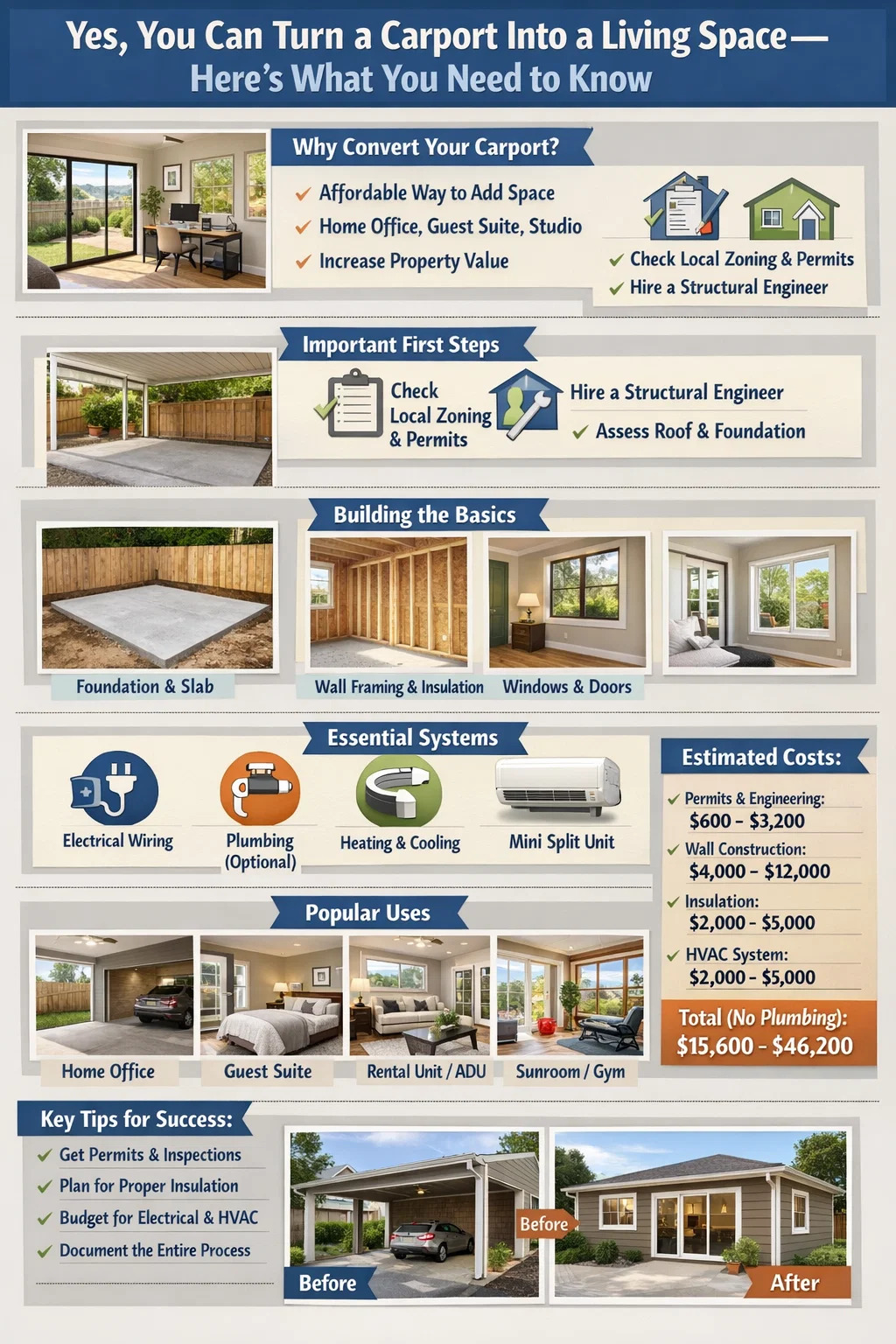
Yes, You Can Turn a Carport Into a Living Space — Here's What You Need to Know
The short answer is yes — converting a carport into a livable room is not only possible but increasingly common. As housing costs rise and families look for affordable ways to add square footage, the carport has become a surprisingly practical target for conversion. Whether you want a home office, a guest bedroom, a sunroom, or a full studio apartment, a carport offers a structural head start that many other spaces simply don't have.
That said, turning a carport into a living space isn't as simple as adding a door and calling it a room. There are zoning laws, building codes, structural requirements, insulation challenges, and budget considerations that all come into play. This article walks through every major aspect of the process so you can go in with clear expectations and a solid plan.
Most carport conversions cost between $5,000 and $30,000, depending on scope, location, and finishes. That's a fraction of the cost of a traditional home addition, which typically runs $80,000 to $200,000 or more. The savings alone make this worth exploring.
What Makes a Carport Different From a Garage — and Why It Matters
A carport is typically a semi-open structure with a roof and one or more support columns, but no full enclosure. Unlike a garage, it lacks walls on most or all sides. This distinction matters enormously when planning a conversion, because you're not just finishing an interior — you're essentially building walls and a full envelope from scratch.
Garage conversions are also popular, but they start with a significant advantage: existing walls, often a concrete slab, and sometimes existing electrical wiring. A carport conversion requires more foundational work on the enclosure side. However, carports often have a roof already in place, which is one of the most expensive components in any construction project. That existing roof structure can save you $10,000 to $25,000 compared to building from scratch.
The structural integrity of the roof must be evaluated before you begin. Carport roofs are designed to handle weather loads — rain, wind, and sometimes snow — but they may not meet residential load-bearing standards without reinforcement. A structural engineer assessment typically costs $300 to $700 and is money well spent before committing to a full conversion.
Zoning Laws and Building Permits: The Step Most People Skip
Before you spend a single dollar on materials, you need to check your local zoning regulations and determine what permits are required. This step is frequently skipped, and the consequences can be severe — from forced demolition of unpermitted work to fines and complications when selling your home.
Most municipalities classify a carport as an accessory structure. Converting it to living space typically changes its classification, which triggers a different set of building requirements. You'll likely need to apply for a residential addition permit, and the converted space will need to meet all applicable residential building codes for your area.
Key Regulatory Questions to Ask Your Local Planning Department
- Is a carport conversion allowed under current residential zoning rules?
- Does the conversion affect required parking minimums on the property?
- What setback requirements apply to the structure's current location?
- What permits are required, and what inspections will be scheduled?
- Does the converted space count toward your home's total square footage for tax assessment?
- Are there HOA restrictions that prohibit or limit such conversions?
In many U.S. cities and counties, a carport conversion that adds livable square footage requires both a building permit and electrical, plumbing (if applicable), and mechanical permits separately. Permit fees vary widely — from $200 in rural areas to over $2,000 in high-cost metros like Los Angeles or Seattle.
One important nuance: some jurisdictions require a minimum number of off-street parking spaces per residence. If your carport is providing that parking, removing it may create a zoning violation. Always verify this before proceeding.
Structural Considerations: What the Carport Actually Needs to Support Habitation
Not every carport is an ideal candidate for conversion. The structure itself needs to meet several criteria before it can safely and legally become a living space. Here are the core structural factors to evaluate.
Foundation and Flooring
Many carports sit on a concrete slab, which is excellent news for a conversion. Concrete slabs provide a stable, level base and are already moisture-resistant. However, a residential floor typically requires insulation beneath it to meet energy codes. You have two main options: apply rigid foam insulation over the slab (raising the floor height slightly) or use a subfloor system with sleepers and insulation between them.
If your carport has no slab and sits on gravel or packed earth, you'll need to pour a concrete foundation or install a post-and-beam floor system. Pouring a new slab for a typical two-car carport footprint (around 400 to 500 square feet) costs roughly $4,000 to $8,000 depending on local labor rates and soil conditions.
Roof Structure and Load
Carport roofs are often built to lighter specifications than attached home roofs. They may use thinner rafters or purlins spaced wider than residential standards allow. A structural engineer will assess whether the existing roof framing meets residential dead load and live load requirements, and whether it can support ceiling insulation, drywall, and any future rooftop loads.
In snow-prone regions, this is especially critical. A residential roof in a climate with 30 pounds per square foot of ground snow load has to be engineered accordingly. Carport roofs in those same climates may have been undersized for convenience or cost savings.
Column and Post Integration
Carports use columns or posts to support the roof. These will either be incorporated into the new walls or need to be relocated. In many designs, the columns become interior wall framing members or are boxed in decoratively. If the columns are the primary load-bearing elements, wall construction must be carefully planned around them to avoid compromising structural integrity.
Building the Walls: Enclosing the Carport Properly
Wall framing is one of the largest components of a carport-to-living-space conversion. You're essentially constructing new exterior walls where open air once existed. Standard residential walls use 2x4 or 2x6 wood framing with exterior sheathing, a weather-resistant barrier, siding, and interior drywall.
A 2x6 stud wall allows for thicker insulation (R-19 or higher with standard batts), which is important for energy efficiency, especially if the converted space will be heated and cooled year-round. Many energy codes now require 2x6 framing for exterior walls in climate zones 4 and above.
Wall framing and exterior work for a carport enclosure typically costs between $15 and $30 per square foot of wall area for materials and labor combined, not including windows and doors. A standard two-car carport with three open sides and 8-foot walls might have 300 to 400 square feet of wall to build, putting this portion of the project at roughly $4,500 to $12,000.
Windows and Natural Light
Residential building codes require a minimum amount of natural light and ventilation in any habitable room. The standard in most U.S. jurisdictions is that window area must equal at least 8% of the room's floor area for light, with at least half of that being operable for ventilation. For a 400-square-foot carport conversion, that means at least 32 square feet of window glass.
Window selection also affects energy performance significantly. Double-pane low-E windows with a U-factor of 0.30 or lower are standard for energy-efficient construction. Expect to pay $300 to $800 per window installed, with more for larger or specialty units.
Insulation: Making the Space Comfortable in All Seasons
Insulation is arguably the most important factor in determining whether your converted carport becomes a comfortable, energy-efficient room or a space that's unbearably hot in summer and cold in winter. Carports have zero existing insulation, so everything needs to be installed from scratch.
| Location | Recommended R-Value (Climate Zone 4-6) | Common Insulation Types |
|---|---|---|
| Ceiling / Roof | R-38 to R-60 | Blown-in fiberglass, spray foam |
| Exterior Walls | R-13 to R-21 | Batt fiberglass, mineral wool, spray foam |
| Floor / Slab | R-10 to R-20 | Rigid foam board (XPS or polyiso) |
Spray foam insulation, while more expensive than batts, offers the dual benefit of air sealing and insulation in a single application. In a new wall cavity where air sealing is critical, closed-cell spray foam at R-6 to R-7 per inch can achieve excellent performance in thinner framing. Budget around $1.50 to $3.50 per board foot installed for closed-cell spray foam.
Don't overlook thermal bridging through the framing. At regular stud spacing, wood framing itself conducts heat and cold, reducing the effective R-value of the wall assembly. Installing a continuous layer of rigid foam insulation (1 to 2 inches) over the exterior sheathing can dramatically reduce thermal bridging and improve overall wall performance.
Electrical, Plumbing, and HVAC: The Systems That Make It Livable
A carport typically has no electrical service, no plumbing, and no heating or cooling system. Adding these elements is the most technically complex and often the most expensive part of a carport conversion. The cost varies enormously based on how far the carport sits from your home's existing systems and what kind of use the converted space will see.
Electrical Work
At minimum, a converted living space needs lighting, outlets, and likely dedicated circuits for heating/cooling equipment. Most residential building codes require outlets every 12 feet along walls, GFCI protection in areas near water, and arc-fault circuit interrupter (AFCI) protection in sleeping areas.
If the carport is attached to the house, running new circuits from the main panel may only require running cable 20 to 40 feet. If it's detached, you'll need either an underground conduit run or a subpanel installed in the converted structure. A subpanel installation for a detached conversion typically costs $1,500 to $4,000 including trenching and conduit.
Plumbing
Not every converted carport needs plumbing. A home office, hobby room, or playroom can function without it. But if you're creating a guest suite, studio apartment, or in-law unit, a bathroom becomes essential — and potentially required by code for the space to be classified as a habitable dwelling unit.
Adding a basic bathroom to a carport conversion, including rough-in plumbing, fixtures, and tile work, adds roughly $8,000 to $20,000 to the project depending on complexity and distance from existing drain and supply lines. Running a new drain line under a concrete slab is labor-intensive and requires saw-cutting the concrete, which alone can cost $1,500 to $3,000.
Heating and Cooling
A mini-split heat pump is almost universally the most practical HVAC solution for a carport conversion. These ductless systems provide both heating and cooling from a single unit, require only a small hole through the wall for refrigerant lines, and can be installed without disrupting existing ductwork. A single-zone mini-split sufficient for a 400-square-foot space costs $2,000 to $5,000 installed, including the outdoor compressor unit and indoor air handler.
If the carport is attached to the home and the main HVAC system has excess capacity, extending existing ductwork may be an option. However, this requires a professional load calculation to confirm the existing system can handle the additional square footage without degrading comfort in the rest of the house.
Complete Cost Breakdown: What a Carport Conversion Actually Costs
Cost is the most common question — and the most variable. Below is a realistic breakdown for a mid-range conversion of an attached two-car carport (approximately 400 square feet) into a finished living space without plumbing, such as a home office or guest room.
| Project Component | Low Estimate | High Estimate |
|---|---|---|
| Permits and fees | $300 | $2,500 |
| Structural engineer assessment | $300 | $700 |
| Wall framing and exterior | $4,000 | $12,000 |
| Windows and exterior door | $2,000 | $6,000 |
| Insulation (walls, ceiling, floor) | $2,000 | $5,000 |
| Electrical work | $1,500 | $5,000 |
| Mini-split HVAC | $2,000 | $5,000 |
| Drywall and interior finishes | $2,000 | $6,000 |
| Flooring | $1,500 | $4,000 |
| Total (no plumbing) | ~$15,600 | ~$46,200 |
Adding a full bathroom increases the total by $8,000 to $20,000. Converting to a full ADU (accessory dwelling unit) with kitchen, bathroom, and separate entrance can push total costs to $60,000 to $120,000 in high-cost markets, though the rental income potential in those same markets can offset the investment within a few years.
Popular Uses for a Converted Carport
The intended use of the converted space shapes nearly every decision you make — from how much insulation to install to whether plumbing is necessary. Here are the most common and practical uses for a carport converted to living space.
Home Office or Studio
Remote work has made dedicated home office space a high-value priority for millions of homeowners. A converted carport gives you a fully separate workspace with physical and psychological separation from the main house. You'll want good acoustic insulation, reliable high-speed internet infrastructure (either ethernet runs or strong Wi-Fi mesh coverage), and sufficient electrical capacity for computers, monitors, and office equipment.
Guest Suite or In-Law Unit
An attached carport adjacent to the main house is well-positioned to become a guest bedroom or self-contained in-law suite. If the conversion includes a bathroom and a small kitchenette, it can function as a semi-independent living unit — ideal for aging parents, young adult children, or visiting family. Some jurisdictions classify this as an ADU, which may require additional permitting and compliance with ADU-specific regulations.
Rental Unit or ADU
In markets where rental demand is high, converting a carport into a rentable ADU can be a strong financial move. A one-room studio in many U.S. metro areas rents for $800 to $1,800 per month, meaning a $40,000 conversion could pay for itself in 2 to 4 years through rental income. ADU conversions require the most rigorous compliance — full habitable space standards, egress windows, smoke and carbon monoxide detectors, and often a separate address or unit number.
Sunroom or Flex Space
If a three-season or four-season sunroom is the goal, a carport is an excellent starting point. Because sunrooms rely heavily on glass for natural light and views, you might design the new walls with large glazed panels or sliding glass doors. This use requires less infrastructure than a full living space — you may not need plumbing and can often use a simpler HVAC solution — but thermal performance remains critical for year-round comfort.
Gym, Workshop, or Hobby Room
Spaces used for exercise, hobbies, or light workshop activities don't necessarily need to meet full habitable space standards in every jurisdiction, but they benefit enormously from insulation and HVAC. A basic gym conversion with rubber flooring, adequate electrical outlets, and a mini-split can be done for under $20,000 in most markets.
Attached vs. Detached Carport Conversions: Key Differences
Whether your carport is attached to the house or freestanding changes the logistics and cost of the conversion in significant ways. Understanding these differences helps you budget and plan more accurately.
- Electrical connection: Attached carports can often receive electrical service through the shared wall, avoiding the cost of underground conduit runs required for detached structures.
- Plumbing access: Proximity to the home's existing supply and drain lines makes plumbing additions far more affordable for attached conversions. Detached carport plumbing can require significant trenching and underground piping.
- Interior access: An attached carport that shares a wall with the house allows for an interior door connection, making the converted space feel like a natural extension of the home rather than a separate building.
- Privacy and rental potential: Detached carport conversions offer greater privacy and are often better suited for rental units, as tenants can come and go independently without sharing entrances with the main household.
- Permitting complexity: Detached structures may face different zoning rules than attached additions. In some jurisdictions, a detached converted carport is classified as an entirely new accessory dwelling unit, triggering a separate set of requirements.
DIY vs. Hiring a Contractor: How to Decide
A carport conversion involves multiple trades and requires work that intersects structural, electrical, and mechanical systems. While some portions are within reach of experienced DIYers, others carry legal and safety requirements that mandate licensed professionals.
In most U.S. states, electrical work above a certain scope must be performed by a licensed electrician. Plumbing beyond simple fixture swaps typically requires a licensed plumber. HVAC work involving refrigerant handling requires an EPA Section 608 certified technician. These aren't just formalities — unpermitted or improperly installed systems can invalidate your homeowner's insurance and create serious liability when you sell the property.
Work That's Reasonable for Capable DIYers
- Wall framing and sheathing (with permit and inspection)
- Installing batt insulation in walls and ceiling
- Hanging and finishing drywall
- Installing flooring over a prepared subfloor
- Painting and interior trim work
Work That Should Be Left to Licensed Professionals
- Electrical panel work, circuit installation, and wiring
- Any plumbing rough-in and drain line installation
- Mini-split installation (refrigerant handling)
- Structural modifications to the roof or load-bearing elements
- Concrete slab work and foundation modifications
A hybrid approach — hiring licensed trades for the systems work while doing finish carpentry and painting yourself — can reduce total labor costs by 20% to 35% on a typical conversion project.
How a Carport Conversion Affects Home Value
The impact on home value depends on what you convert the carport into and whether the work is permitted and properly completed. In general, adding livable square footage to a home increases its appraised value — but the return on investment varies considerably by market and use.
According to real estate data, finished living space adds approximately $50 to $150 per square foot to a home's market value depending on location. A 400-square-foot carport conversion completed at a mid-range quality level could add $20,000 to $60,000 in value to the right home in the right market. In high-demand urban markets, the addition of a rentable ADU unit can increase value by considerably more.
On the downside, removing parking can reduce home value in areas where off-street parking is scarce and highly valued. Buyers in cities where street parking is extremely limited may actually discount a home's value if the carport is converted and no parking replacement is provided. Always weigh the local parking premium before eliminating the carport's original function entirely.
Unpermitted conversions can be a liability. When a home is sold and the buyer's lender orders an appraisal, unpermitted additions are either excluded from the square footage count or flagged as a deficiency. In some transactions, lenders require that unpermitted work be legalized or removed before closing. Always pull permits — it protects both your investment and your legal standing.
Practical Tips Before You Start Your Carport Conversion
Having guided you through the major components of the project, here are the most important practical steps to take before breaking ground.
- Consult your local planning department first. Bring your property's address, a site plan, and a brief description of the intended use. Ask specifically about zoning, parking requirements, and permit requirements. This single step can save thousands of dollars in mistakes.
- Hire a structural engineer. Before committing to the project, have the carport's roof and any existing slab professionally evaluated. A few hundred dollars now can prevent catastrophic problems later.
- Get three contractor bids. Prices vary enormously by contractor and by how busy the local construction market is. Getting multiple bids gives you market calibration and negotiating leverage.
- Budget a 15% to 20% contingency. Renovation and conversion projects consistently run over initial estimates. Hidden issues — deteriorated roof framing, undersized electrical service, cracked slabs — are common in older structures. Plan for surprises.
- Decide on the intended use before designing. Everything from wall placement to insulation levels to electrical load calculations depends on how the space will be used. Locking in the use case before design begins avoids expensive mid-project changes.
- Think about heating and cooling from day one. HVAC is not an afterthought. The type and size of the system affects where electrical circuits go, where penetrations are located in walls, and how much insulation you need. Plan HVAC in parallel with wall framing, not after the fact.
- Document everything. Take photos before, during, and after each phase of work. This documentation is invaluable if you ever need to prove the work was done correctly, file an insurance claim, or explain the conversion to a future buyer.

 浙公网安备 33068302000509号