 English
 日本語
日本語 русский
 Español

Customer expresses intent; Communicate between the two parties; Provide analysis reports to customers; Reach a cooperation intention.
For most homeowners who want to save money and provide shelter for their cars, a gravel foundation is widely considered the cheapest and most cost-effective option.
If your budget is very tight, consider the following money-saving tips:
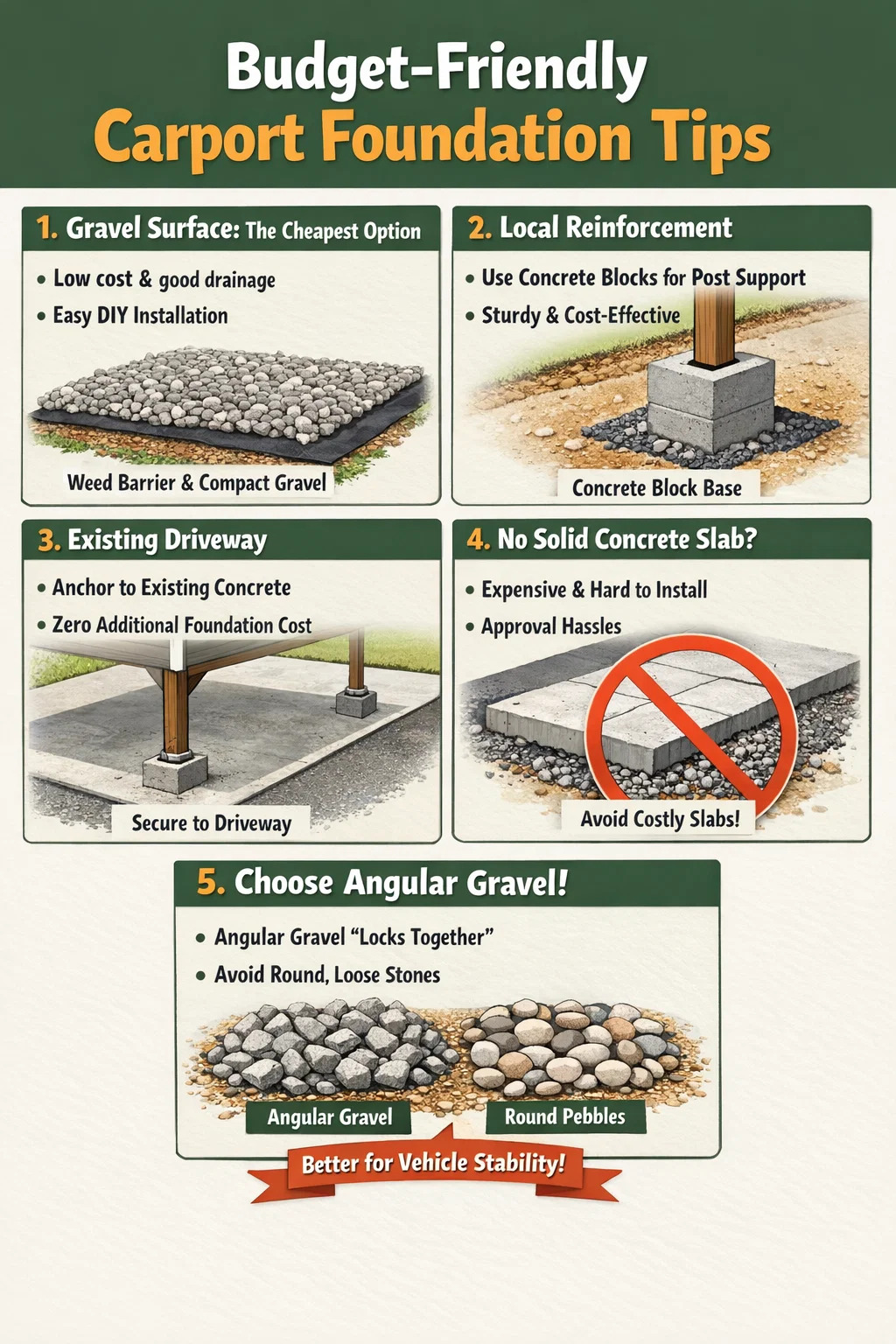
1. Gravel Surface: The most economical "ground cover"
Unlike laying concrete, you don't need to rent a concrete mixer or hire professional masons; you can do it yourself.
Low cost: Buying a few tons of gravel (usually the small, angular stones used in construction) is much cheaper than pouring a solid concrete slab.
Good drainage: The gaps between the stones allow water to drain directly into the ground when it rains, preventing mud on your tires and avoiding water accumulation like on a concrete surface.
Fast construction: Simply level the ground, lay down a layer of weed barrier fabric (to prevent weeds from growing), and then spread and compact the gravel.
2. Local Reinforcement: Spend money where it counts
While the ground can be covered with gravel, the support posts of the carport should absolutely not be placed directly on the gravel.
Money-saving solution: Dig holes only at the points where the posts will be, and embed simple precast concrete blocks or pour a small amount of concrete.
Principle: This is equivalent to giving the posts "feet" without needing to create a "large foundation" for the entire area. This saves a significant amount of material costs while ensuring the carport remains stable even in strong winds.
3. Existing Driveway: A zero-cost "ready-made foundation"
If your home already has a flat, paved area or an old concrete driveway, don't bother with a new foundation.
Direct installation: Use large expansion bolts (or chemical anchors) to directly secure the carport base to the existing hard surface.
Money-saving point: The foundation costs are almost zero; you only need to purchase the materials for the carport itself.
4. Why avoid a "solid concrete slab"?
Expensive: Pouring a complete concrete slab large enough to park two cars often costs more in materials, formwork, and labor than buying the carport itself. Complex procedures: In many places, large areas of concrete paving may involve more complex approval processes and drainage management fees, while gravel foundations are usually considered temporary or semi-permanent structures, with fewer restrictions.
5. A practical money-saving tip:
If you plan to use gravel, remember to choose angular gravel (such as crusher run) instead of round river pebbles.
Angular stones will "lock together" under repeated pressure from vehicle wheels, forming a very strong surface; round stones, on the other hand, will roll around like loose sand, making it difficult for vehicles to drive on.

 浙公网安备 33068302000509号