 English
 日本語
日本語 русский
 Español






Customer expresses intent; Communicate between the two parties; Provide analysis reports to customers; Reach a cooperation intention.
Content
Converting a carport into a garage is a common renovation project many homeowners consider to increase home security and storage space. Simply put, this process transforms an "open-air shelter" into a "closed room."
While feasible, there are many practical details to consider:
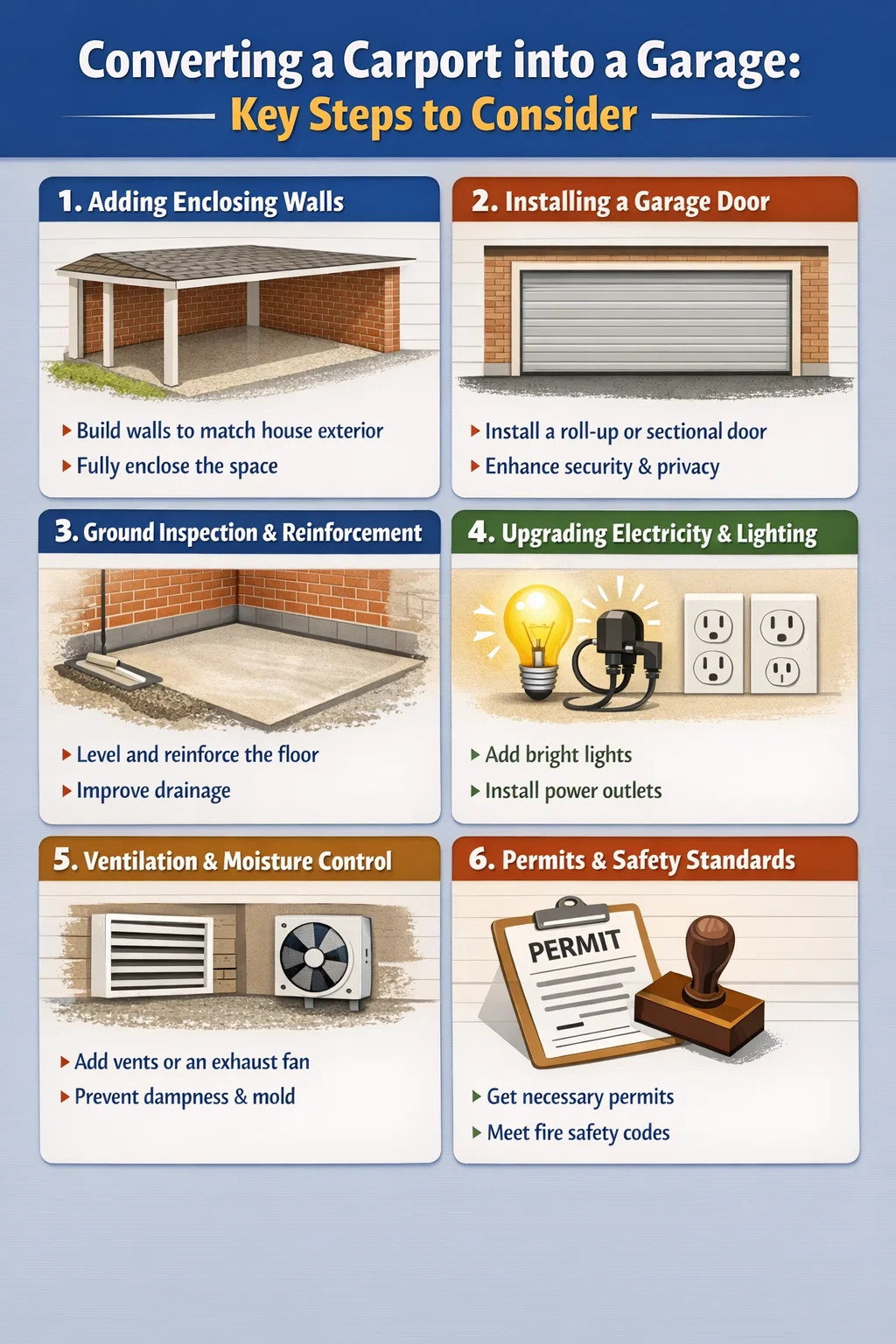
1. Adding Enclosing Walls
This is the most obvious change. Originally, a carport is just a few posts; now you need to add three walls based on the existing frame structure.
Common practice is to use materials consistent with the main house's style, such as brick, wood panels, or metal sheeting.
The walls are not only for aesthetics but, more importantly, to provide protection from wind and rain, completely enclosing the previously semi-open space.
2. Installing a Garage Door
Since it's becoming a true garage, the front must have a garage door that can roll up and down or open and close horizontally.
This step is crucial because the garage door requires extra space for tracks and a motor.
With this door, your car and belongings will no longer be exposed to passersby, significantly increasing privacy.
3. Ground Inspection and Reinforcement
Many carports have simple concrete slabs or gravel floors, and may even have a slight drainage slope.
To convert it into a garage, you may need to level the ground or lay a stronger concrete floor to support the extra weight of the fully enclosed structure.
You also need to ensure that rainwater doesn't flow into the enclosed space through the doorway.
4. Upgrading Electricity and Lighting
The original carport might only have a motion-activated light, or no lights at all.
After becoming a garage, it will be darker inside. You'll need to rewire and install bright overhead lights.
Considering you might charge things, use power tools, or store an old refrigerator there, adding several power outlets is also necessary.
5. Ventilation and Moisture Control
Once the space is enclosed, air will no longer circulate as freely as before.
If you park a car that has just been rained on, or store a lawnmower inside, odors and dampness can easily develop.
During the renovation, it's usually necessary to leave small ventilation openings in the walls or install an exhaust fan to prevent mold or rust.
6. Legal and Permitting Requirements (Very Important)
In many places, the building standards for carports and garages are different. Approval Procedures: Because a garage is considered a "fully enclosed building," it is subject to stricter regulations regarding fire safety and distance from neighboring properties. You will typically need to apply for a permit from the relevant local authorities; you cannot simply begin construction without permission.
Safety Standards: Enclosed spaces have specific fire safety requirements, especially if the garage is attached to the house. The fire resistance of the walls and doors must meet the required standards.

 浙公网安备 33068302000509号